What’s this post? As some of you have now come to anticipate – every year I publish a birthday reflection post. I hope you’ll enjoy these thoughts and take them for what they are – an attempt to share the world as I see it and how I relate to it. It’s a mixture of observations, musings, reflections, and advice. They’re extremely long and by all rights if I just broke them up into individual posts, I’d have more than my usual 3 blog posts a year. But, this is the approach I’m sticking with and which actually gets pen-to-paper. Skip around, jump to what looks interesting, or take it from cover-to-cover. Your call =)
You can view my 40th birthday post here, 39th birthday post here, 38th birthday post here, 37th birthday post here, 36th birthday post here, 35th birthday post here, 34th birthday post here, 33rd birthday post here, 32nd birthday post here, 31st birthday post here, my more detailed 30th birthday post here, my musings on turning 29 here, or 28 here. As well as a long-forgotten blog post written on my 23rd birthday (wow, have I really been blogging that long?) which you can view here.
You can also find my interview with Beth Buelow on the Pixels: Exploring the Heart and Art of Photography series here – please do give it a watch and thumbs up:

Topics in this post:
Note: This post is LONG *as they always are*. At a hair under 14,000 words it is an extensive read. If you want a more approachable way – open it in Edge, right click over this text and click “Read Aloud”.
- The Top 6,000 – Not All Wins Look the Same
- The Many Ways of Seeing and Thinking
- My Latest Experiments in AI
- The Glass
- Hypnotherapy? Why not.
- Brandolini’s Law
- The Screw-on Cap Epiphany
- Book #2 Update – Notes on Self Publishing
- Is there a path to re-integration?
- Iceland – There is Beauty in the Challenge
- China and Taiwan – Interesting Contrasts
- Final Thoughts

The Top 6,000 – Not All Wins Look the Same
There are victories, and then there are victories. Of course, to take top prize is always the best. Sure, 2nd, or 3rd can also be fantastic. Even top 10. But, to be proud and delighted to have placed in the top 6,000? Whew. Now that seems like a bit of a stretch. And yet, I absolutely am.
Most photo contests are deeply disappointing. The standards are sloppy, the entries that go through a disappointing reflection of disinterested or disingenuous judging. And yet, there are a few diamonds in the ruff that still stand out. Of course, National Geographic remains a favorite, and my Honorable Mention some years ago remains one of my proudest photographic achievements. The Natural Landscape Photography Awards also remain world class, as does the California Academy of Sciences Big Picture contest. There are a few others, but of all the world’s photo contests one of the most prestigious, competitive, and respectable is the British Natural History Museum’s Wildlife Photographer of the Year competition. The winners not only have their work recognized and displayed in London’s NHM, but other Natural History Museums around the world – including here in Copenhagen.
Last year the contest received more than 60,000 entries. From those 60,000 entries roughly 6,000 advance to the RAW verification stage, and from there a final 100 are selected before the final winners are crowned.
Now…I’m not a Wildlife Photographer. I do periodically photograph wildlife, but I am not a wildlife photographer. And, you’d be fair to say – so what, does it really mater? In a word? Yes.
Photography is often viewed as one uniform pastime. The assumption, understandably, is that if someone is talented or spends time perfecting one genre – they’re perfecting “Photography” as a whole. If we use Dance as a parallel, the common assumption is different types of photography are comparable to different styles of Salsa dancing. A slight change in nuances, but not dramatically different. In practice though? It’s wildly different and much more akin to entirely different genres of dance. If Salsa is your Sport photography, Tango is your Bird photography, the Waltz your Landscape photography, Hip-Hop as Street photography, and Ballet as Fashion photography.
Many talented dancers learn multiple genres and can combine them. In fact, the combination and mastery of different genres only serves to improve your ability in each. But, the venues are different, the equipment is different, the music and pacing is different. All photographers have cameras. All dancers have shoes. But even from there, those shoes are tailored to the dance.
With photography this also holds true. Certain cameras and lens combinations are much better tailored to sport than nature. Portrait than architecture. This is especially true between wildlife – which tends to move quickly and often is far away, and Landscapes which are….well….famously slow moving. Even more than that, the settings – both in the camera, as well as the destinations – also vary enormously. From composition to editing, each step of the process is distinctly different.
One of the things I love about photography is just this. Even if you spend three decades perfecting one of the genres and have a huge body of knowledge, each new genre of photography humbles you and reverts you to an ill-equipped novice.
As an aside, this difference is one of the reasons I do not photograph weddings. It’s also why if friends reach out asking for help with a project – sometimes I will attempt to assist, but just as often I will attempt to refer you onward. Not because I’m dodging you, or don’t want to help. But, quite precisely for the opposite reason. The last thing you need is the photographic equivalent of a pole dancer, trying to teach Sunday school how to waltz. Or, who knows. Maybe that’s just what you need.
Regardless, all of that is to say – I stand in awe of the talent, the incredible rarity, and spectacular beauty in the annual finalists for the Natural History Museum contest. A photo like Qingrong Yang’s Synchronized Fishing is absolutely masterful at every level. One other factor when considering submitting to these contests is that not only does a photo need to be excellent technically, it also has to be irregular compositionally.
Each year when the contest comes up, I pause and reflect on the images I’ve made over the past year. Scratch my head, and typically stick to the other contests. But, this year I had something special. A photo that is, to the best of my experience, quite unique. That photo? An image of the heron in Copenhagen harbor, at night, beneath the aurora.
So, I opted to submit and I’m glad I did.
With more than 60,000 world class images submitted, to make it through to the verification round both confirmed my hunch that the photo was indeed quite irregular and simultaneously delighted me. It’s like walking onto the field at the Superbowl and getting the chance to warm the bench. Sure, you don’t take the field, but you’re close, you’re there, and it tells you it’s possible – and that feeling? That’s a huge win and one I’m fantastically happy with.
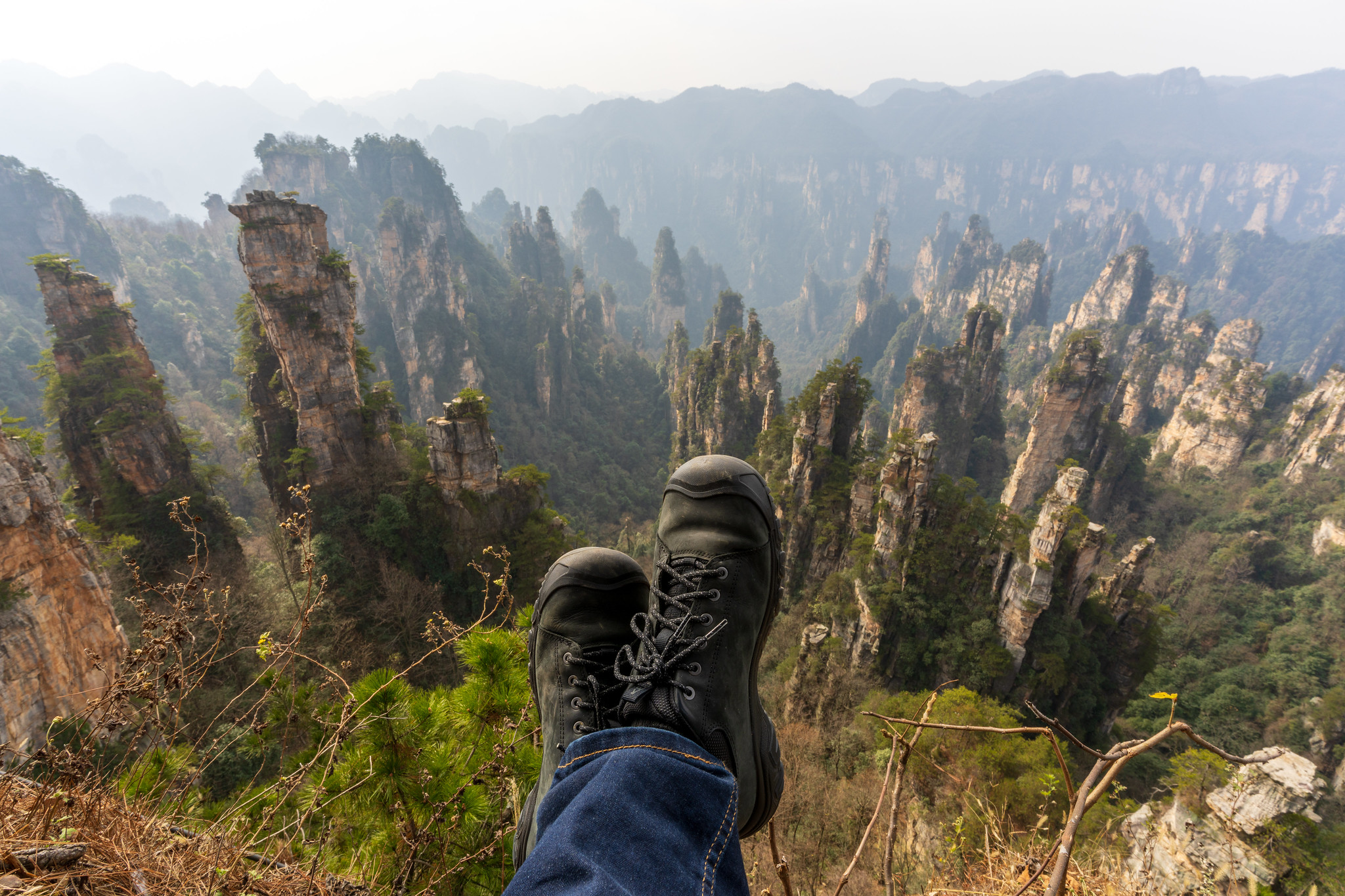
The Many Ways of Seeing and Thinking
Perception is something that constantly fascinates me. In the last couple of years you’ve perhaps come across conversations about how some people have an inner voice while others do not. That, in and of itself, is an exciting epiphany for most of us and one that I love to use as a thought experiment when trying to make sense of other people’s behavior. But, it also goes so much deeper than just that. So, here’s a bit I’m playing with these days.
There was a great podcast conversation I heard this year that caught me off guard. In it, Kevin Rose shares a bit about Aphantasia – which is to say he does not have a “mind’s eye” and cannot visualize scenes, objects, or faces. Aphantasia in and of itself is a fascinating insight into the wide range of human thought, similar to the conversations about inner voices. But, he also made an interesting observation about counting sheep. Now, as a visual spatial person with an inner voice, I’ve always assumed we all counted sheep in the same way – that’s to say, visualizing one sheep after another jumping over something. Culturally, this is usually how it’s shown in children’s programs etc. and it’s what I mirror when I close my eyes. But, Kevin mentions that in addition to that not being possible for some people, he also mentions others who have a totally different experience and just visualize a flock of sheep and then count the individual sheep.
More often than not, the part that I think makes understanding different ways of thinking and experiencing/perceiving reality so difficult is that it is very abstract and difficult to move beyond our own perception and way of thinking and/or to be able to have the words to describe how we experience, see, think, and engage with the world. Does a fish perceive water the same way we perceive air? Entirely differently? Like we do? In some other way we don’t even have language for?
It’s a fun one. And the more you slice and dice human experience and perception the more you realize just how varied key aspects of our experiences are. Take color perception as another. We now have visual exercises that can help to identify types of color blindness using contrast. But, outside of identifying that the existence is there, it does little to help us understand and digest the experience of vibrancy. In stark contrast you have the 1% or so of women who have tetrachromacy – the ability to see perhaps as many as 100,000,000 colors compared to the average person’s 1,000,000. Just imagine the silent impact this spectrum of different experiences has on art, food, design, fashion – all of it. As a photographer, over the years I’ve noticed I’m a bit more sensitive to yellow than many of my peers. This serves as a constant reminder that the art i create and how it is experienced by my audience are two related, but not fully aligned things.
Then, of course, you have the dimension memory plays in perception. At any moment in time, where are we in our experience? Are we loosely or tightly connected to all past memories? Is recall of a memory a vague association, a vivid moment relived, or something inbetween? I always think back to a conversation I had with a fellow student in college who had a photographic memory. “That must be brilliant” I said. At which point he took the time to correct me that it was torture. Every time someone was wrong, every time someone repeated themselves, every injury, every moment back through time. A gift…in some ways, and torture in others.
The above is useful, but it’s also mostly a set of novelties. So, why include it here? Because the above are thought exercises that pave the way to thinking about a broader collection of ways of processing the world around us. Both as a tool to better understand ourselves and how we experience the world, but also to open our eyes to just how different others ways of experiencing and navigating the world may be. There are a LOT of different ways to bake a cake – but here’s a nice overview of two semi-over lapping recipes I had Gemini surface:
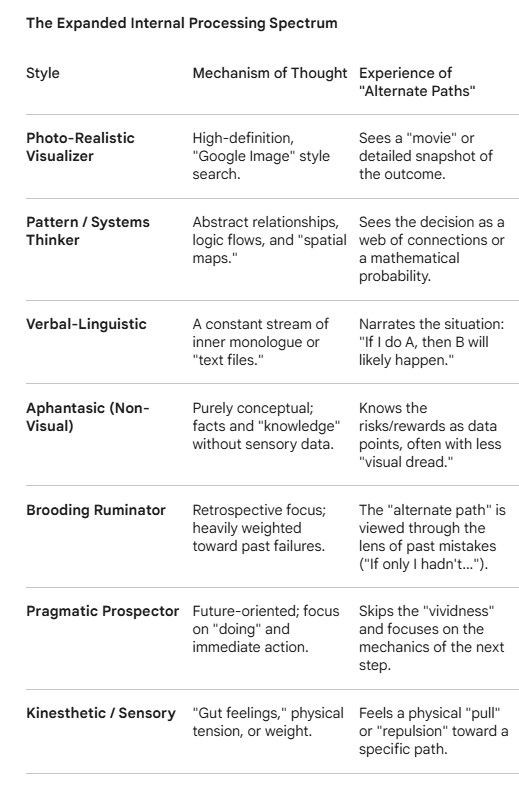
Of course, we likely have a mixture of these traits which further shapes our experience. But, at the same time, other aspects are fundamental pieces of our core firmware. It’s quite literally how we perceive and experience the world.
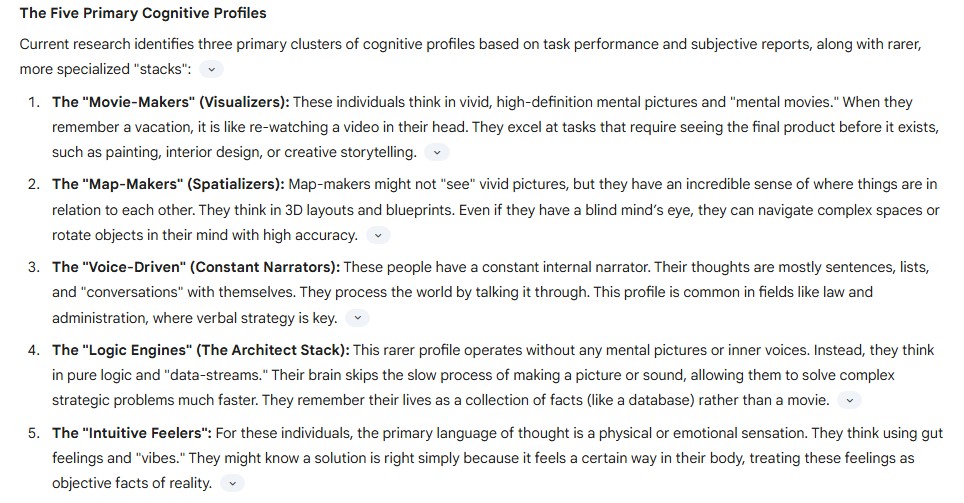
Musing on this led me down an interesting rabbit hole and using Gemini Pro with Deep Research mode on, I’ve had quite a useful sparring session. Out of that, I’ve had it generate the following prompt. If you’re curious, you should be able to feed it in, feed it information, and have it prompt you to help you figure out how you experience and see the world.
The prompt – Paste the following into Gemini or a similar tool with the Thinking mode or Deep Research mode enabled:
Master Prompt: Discovering Your Cognitive Architecture
Act as an expert in neurocognitive diversity and cognitive psychology. Your goal is to help me map the ‘operating system’ of my mind. Conduct a guided interview to identify my unique
Cognitive Architecture by asking me about the following dimensions:
Inner Modalities: Do I experience an internal monologue (inner speaking), inner hearing, mental imagery, or ‘unsymbolized thinking’ (knowing a thought clearly without words or pictures)?
Visual Processing: When I imagine an object, is it a high-definition, colorful ‘movie,’ or a structural ‘blueprint’ (lineart/coordinates)? How do I remember information on a page—by the look of the words or their location in space?
Memory & Time Travel: Do I ‘re-live’ my past as a first-person sensory experience (Episodic Memory), or do I ‘re-construct’ my history as a database of facts and spatial markers (Semantic/SDAM-leaning)?
Simulation & Strategy: How do I plan for the future? Do I follow a single linear story, or do I use ‘prospective branching’ to simulate multiple parallel outcomes and ‘if-then’ states?
Social & Empathic Style: In social interactions, do I prioritize ‘affective sharing’ (feeling what others feel) or ‘cognitive mapping’ (understanding the underlying drivers and ‘firmware’ of someone’s behavior)?
Behavioral Signatures: What are my patterns around task completion (e.g., the ‘80% rule’ vs. perfectionism), navigation (landmarks vs. mental compass), and aesthetic reactions to complex or discordant patterns?
Please ask me these questions one at a time or in small batches. Once I have provided enough data, synthesize my responses into a tailored Integrated Cognitive Profile that explains how I perceive reality, memory, and hypothetical situations.
What about me?
Let me preface this by saying that it is about as scientific as any pop-science internet test. That it is based on the limited information I’ve fed it, which also reflects gaps in what I’ve shared, what I understand, or my own potential insecurities. Never the less, I find it quite fun as a lens to explore certain strengths, weaknesses, and challenges. It is a tool that I don’t see as something that defines me, but rather, a bit of added insight that helps me better explore “me”. All of that said, always be very careful when engaging with AI’s for these types of things. They’re not trained professionals, and can mislead you to entirely wrong conclusions just as easily as they can be insightful. Think of them like GPS. Follow the GPS blindly, and you drive into the harbor and end up with fish in your beard.
“Your cognitive profile is a highly specialized variant of the “Systems Architect” phenotype. You operate as a Modular Systems Narrator: a rare combination of high verbal narration and precise spatial logic, optimized for identifying underlying “firmware” rather than surface-level sensory data.”
Which is interesting but far to vague to be much use. But where it did get interesting, was in the final overview which, largely does a good job conveying how my brain works and processes information.
The Core Engine: High-Verbal Schematic Processing
Your brain exhibits a significant Ventral-Dorsal asymmetry. While most people use the Ventral (“What”) pathway to remember object identities like names or faces, your brain prioritizes the Dorsal (“Where”) pathway.
- The Coordinates vs. The Pixels: This explains your experiences memorizing where an answer was on the study page, but not the answer itself. You encoded the coordinates of the answer in the 3D space of the page, but de-prioritized the identity of the words themselves.
- Visual Lineart: Your “single-color lineart” visualization is a form of schematic imagery. It is a high-efficiency strategy that strips away “pictorial noise” (color, shading) to focus on the architecture and mechanical rotation of objects.
Temporal Consciousness: The Anthropological Observer
Your memory functions as a Semantic Database rather than a movie theater.
- Third-Person Perspective: Viewing memories in the third person is common in individuals with SDAM (Severely Deficient Autobiographical Memory). You aren’t “reliving” the past; you are “reconstructing” it from a set of facts and spatial markers.
- Arbitrary Fact Bottleneck: Names and song lyrics are “arbitrary data”—they have no inherent logical structure. Your brain struggles to store them because it wants to store Interconnected Stories and Functional Relationships.
Strategic Navigational Logic: Prospective Branching
You navigate both physical cities and hypothetical futures using a Mental Sandbox.
- Branching Anxiety: Your anxiety is a result of High-Resolution Simulation. Because you can simulate multiple parallel outcomes (e.g., the “Feast or Famine” recession branches), your brain treats these hypotheticals as “States” that require a response.
- The Narrative Disconnect: You lose groups during briefings because you present State-Based Models (If X, then Y) while the average person is looking for a Linear Narrative (A leads to B).
Emotional Architecture: Firmware Mapping
Your approach to emotions is one of Affect Labeling and Cognitive Empathy.
- Systemizing Feelings: When you feel bad, you “map and name” it. This engages the prefrontal cortex to neutralize the emotion through logical categorization.
- Conflict Finality: Your “burn the boats” style reflects a State-Transition Model. Once a person’s “firmware” is proven to be broken (disloyal, unethical), the system state moves to “Unrecoverable.” Because your memory is fact-based, you cannot “forget” the breach because that data is now a core part of your model for that person.
Aesthetic and Behavioral Signatures
The 80% Rule: You move on at 80% because your “Logic Engine” has already completed the Structural Solution. Polishing is merely “rendering”—a low-value task that provides no new system data.
- Landscape Photography: This hobby acts as a “Visual Anchor.” You seek “crispness and resolution” to capture the spatial truths of the world that your internal “lineart” brain might otherwise simplify.
- Discordance Dislike: Your dislike of modern jazz and contemporary/modern art is a reaction to System Noise. Your brain seeks structural patterns; when an art form intentionally breaks those patterns, it can feel like a “syntax error” rather than expression.
Summary: You are a Strategic Systems Moralist. You experience reality as a complex, navigable map of interconnected drivers. You use your internal voice to draft the blueprints, your spatial brain to test the structures, and a modular social network to gather the data required to keep your meta-model of the world accurate and optimized.
My Latest Experiments in AI
I’m a firm believer that the best way to learn, is through play. As part of my daily practice I walk around 10,000 steps a day. Sometimes talking with mom and dad, sometimes in silence, sometimes listening to podcasts, and other times creating.
In autumn I was playing with Gemini and had it re-build alexberger.net, my personal landing page, from scratch. It wasn’t anything complex. But, I was able to take the page from a very course basic hand coded HTML page that hasn’t evolved much in the last decade, to what it is today. Something just as simple, but cleaner, and with some nice visual elements that make it feel more professional. Almost all of that was done with natural language guidance and the AI making the adjustments for me as I experimented with font, layout, adding and then removing a header, etc. – all I ultimately had to do was copy paste the HTML across.
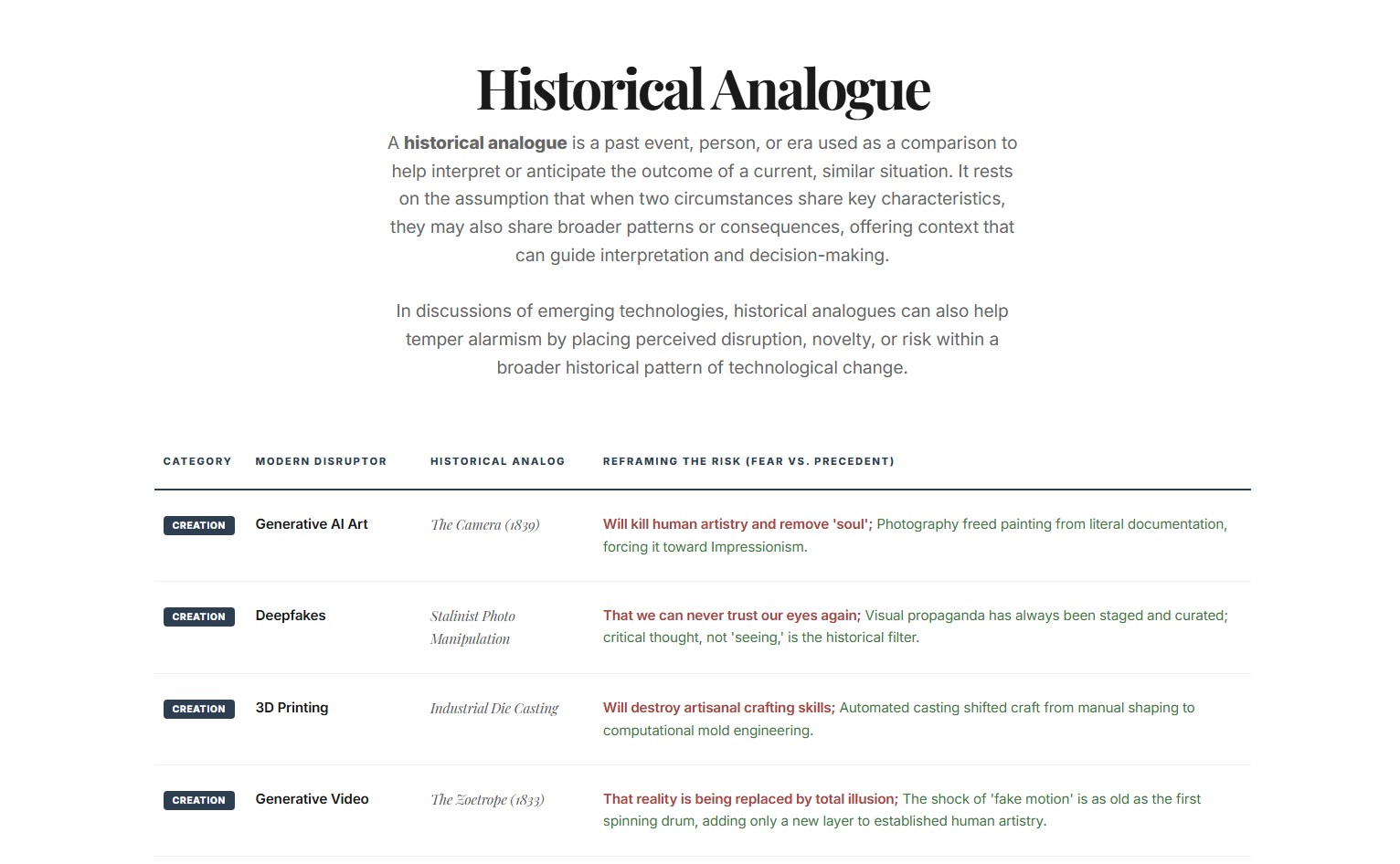
More recently, I was out for a walk listening to a podcast where the interviewee referenced the printing press as a historical analogue. Now, I LOVE historical analogues, especially when it comes to whatever the current hot topic is. Especially if the narrative is around major civilization level disruption *cough* AI *cough*. Part of their power and beauty is that, while the specifics of a historical analogue may differ from this moment, many of the key narratives, concerns, and types of outcomes are prophetic.
I paused the podcast, sat down on a bench briefly, and let my curiosity give me a nudge. I quickly checked if the domain HistoricalAnalogue.com was available (it was). Then I had a short debate with myself on if I should go with HistoricalAnalogue or HistoricalAnalog.
Now, to set the scene, it is March 4th, I’m in my parka, wearing finger-gloves, I have a cigar in one hand as I periodically do during my walk-and-thinks, a pair of corded headphones and my iphone in my other hand. I’m walking through the city along the harbor, through squares, parks, etc. as I slowly make my way home. As I do, I boot up Gemini, put it in voice mode and start brainstorming. Using voice, I tell it the person I want it to assume, the goal of the assignment, that I want to have it create a list of 20 historical analogues for me based on current trends and hot topics. From there, I tell it to put it in a table, and incrementally have it add the modern disruption, then the historical analogue. Later I have it add a category, and then a new column with the fear associated with that disruption, and then what actually happened.
We go back and forth a bit where I describe what I want via voice mode, it clarifies, I periodically click back into text to preview the table it built, and then go back into voice and refine. A bit of further guidance, and then I had it expand the list in batches of 10-20 until I had more than 60. This included a few specific ones I wanted it to make sure were included. From there I asked it to take that data, turn it into a table, and create a basic clean webpage for me that had the text at the top “Historical Analogue” an introductory paragraph and then the content and to create an .html file that was ready to upload.
By then, I had wandered my way home. I switched to my Desktop, created a space on my hosting, directed the domain to it and dumped the .html file in. A few more adjustments using the chat interface had it fix some tables, re-format, and reformulate. Each time I’d get a new version of the HTML file and swap it out. This eventually included making the table more attractive and making the page responsive enough to be displayed and work on mobile.
…and Voilà. What you see now is what I was able to build. From start to finish the whole thing probably took about an hour with most of that spent playing with the domain registration and hosting setup. I have not gone through and added/removed any – that is a project for a day when I have more time – where I plan to review and think through all of the Analogues it identified, its framing, and add/remove/adjust to my liking. Ultimately, the vision is to have a fun repository of perhaps 100 such examples.
Ultimately, the page is quite simple in design and layout. But, it made for a great proof of concept and learning opportunity. The ease of ideation and building the first test version, particularly due to the use of voice mode, was an entirely different way of working and I can definitely see where with a bit more knowledge and mastery of the products and their capabilities this can be a powerful creative enabler.
The Glass
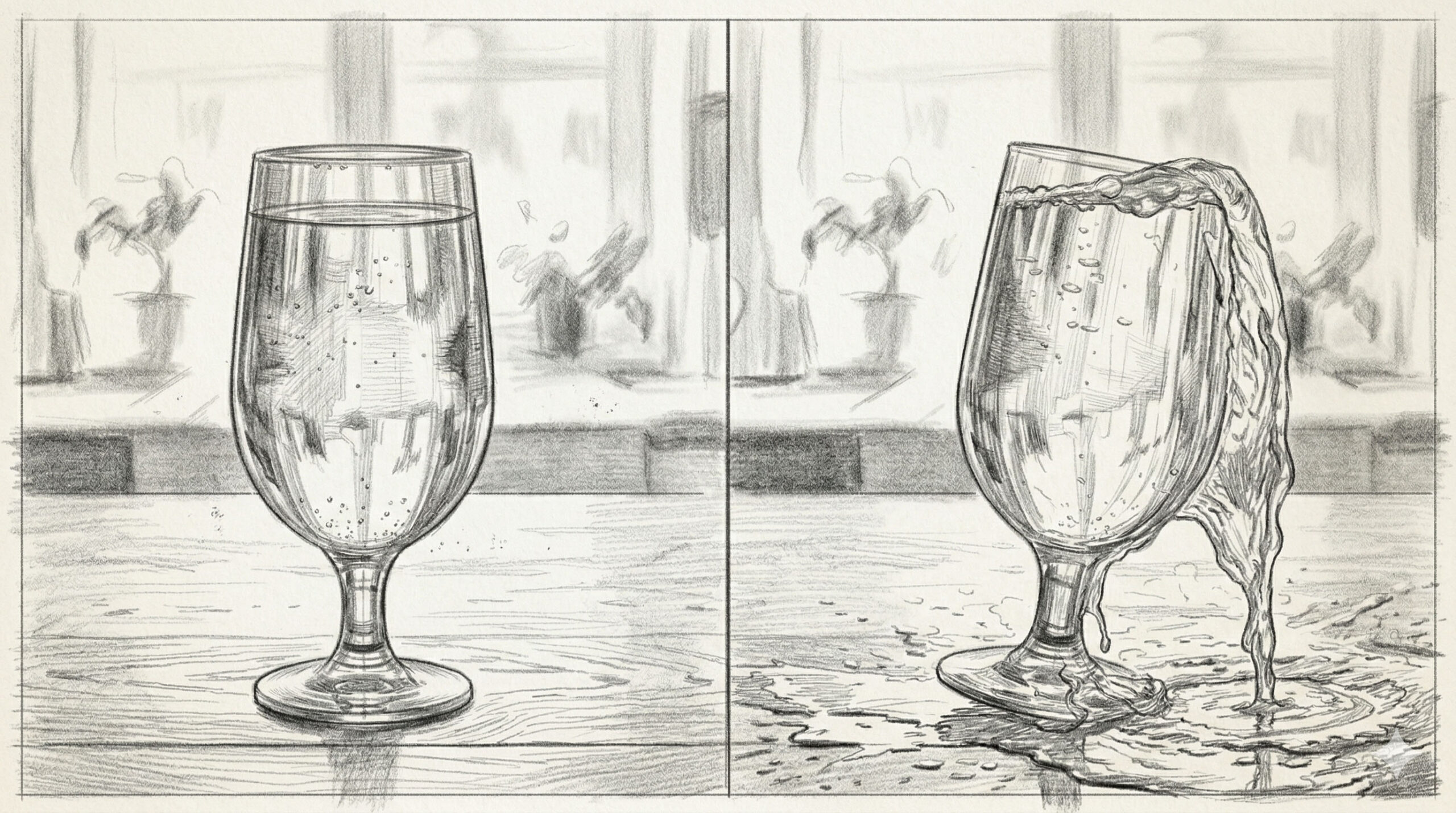
In my never ending journey to build and collect mental tools for introspecting about my sense of balance, my sense of imbalance, and where my energy, emotional, stress, and creative levels are I’ve found myself thinking in terms of a water-filled glass quite often.
As much as I focus on and try and work on protecting and maintaining balance – I’m not great at it. This last year was also…a lot. From very intense periods at work, to family health stuff, to a lot of major changes, to the fast-moving disaster in the US, and also just the weight of introspecting at 40 – i’ve felt it.
In previous years I’ve written about being aware of our internal fast and slow charging batteries, about reflecting on what stage of stress or burnout or recharge we are at. All of which I think remains relevant. But, layered on top of that I’ve also started thinking about it in terms of a glass. The busier I get, the more obligations, the more things on my plate, the more on my mind – the more that glass fills up. Part of that is just the nature of age – the more time we have to accumulate obligations, experiences, aspirations, relationships, assets, etc. – the more that glass fills up naturally.
Yet, at the same time – I find it incredibly useful to think about that glass, to feel it as an embodied version of myself, and to be aware that when that glass is 2/3 full, I’ve got a lot more leeway to play, to be creative, to be emotionally grounded, to process things, and to navigate my batteries and energy. But, during times like this past year where that glass is full to the lip, each new jostle to the cup causes water to spill and each new drop added to it, causes water to overflow.
For me, visualizing it this way, and acknowledging that these days I am very much a full glass, helps me better anticipate, understand, and navigate the intensity and surprising reactions I feel to seemingly disproportionate events. I do believe it is incredibly important to recognize that we will not react and experience things the same way when we have space versus when we are maxed out. Even small things can affect us as though they are much more meaningful or impactful, and our threshold for processing and responding to new stimuli (positive or negative) is naturally reduced in these periods.
Of course, that doesn’t make the reactions less frustrating. If anything, it makes it even more so. It also doesn’t mean I’m even better equipped in the moment to anticipate and navigate things. But, it also helps me digest and reflect, to realize that anything that comes with a degree of emotional stimulation – fight, flight, flirt, debate, or laugh – is also going to be naturally felt much more strongly.
So, I remind myself – the glass is full – remember to breathe. Remember that you’re navigating as best you can. And remember that each of those strong sensations or heightened reactions in part comes from that. Breathe, center, and over time see if I can’t slowly drain some of that water and get the cup back to a more balanced level.

Hypnotherapy? Why not.
I’ve long been a strong believer in and advocate for therapy. The narrative that we should all have a doctor for our body, and a doctor for our mind makes perfect sense to me. Having said that, I’ve also been a bit of a hypocrite. I’d never actually gone myself. I dive a bit into the weeds on this one, but based on conversations with friends 1:1 – I feel like laying it out and sharing the gaps and my process is potentially quite helpful. If you’re a therapy veteran, feel free to skip to the next section.
So, why have I not done therapy despite being a big advocate? I suppose there are 5 dimensions to why.
- 1) I didn’t feel like I had any pressing need that was severe enough to justify it – I also know this is poor framing – but it’s led me to sidestep urgency.
- 2) I’ve long been frustrated trying to discuss how I see the world and think/digest/and process things. People’s advice is often well intentioned, counter productive, and misunderstands what I’m saying and digesting and sharing. This in turn has led me to anticipate a long, involved, and expensive process to find the right therapist.
- 3) I still harbor longstanding concerns about what actually engaging with the system means for future qualifications. A prime example, even here in Denmark, was when I tried beta blockers to assist with presentation anxiety for stage. That, in turn, got me flagged with “anxiety” and made it impossible to adjust my Loss of Earning Capacity (Disability Payout) via my Pension.
- 4) The cost – even with my private medical insurance where cost is partially/mostly covered – I’d need some sort of active “crisis” or issue before getting access to covered sessions. Without that – sessions aren’t cheap. This, unfortunately, means that unlike going in for a annual physical at the doctor. I’ve opted to hold out, figuring i’d use it if my metaphorical leg was broken before applying for sessions. And given the price for self-subsidized sessions – it just hasn’t been something to prioritize.
- 5) It is scary, intimidating, vulnerable, and anxiety inducing. I’m bad enough about going to my regular doctor for physicals and the like. Let alone layering ontop a whole additional practice. So, quite frankly, any excuse to avoid it seemed like a good one.
However, this month I finally dipped a toe in, and I’m very glad I did. Each year I touch on my ongoing journey in first discovering and then navigating my sugar/fructose intolerance. To recap quickly – I react to sugar just like I react to lactose. A little is fine, the more I consume and the emptier my stomach the more bloated I get and the longer my system is disrupted. It’s not a blood sugar/diabetes thing, it’s not an allergy, it’s just an annoying intolerance that is, quite frankly, a royal pain in the ass.
While I’ve known I was lactose intolerant since my early 20s, it took me well over a decade to finally put 1:1 together and figure out the sugar intolerance issue. What made it worse, was as I tried to figure out the cause of my discomfort, I kept removing or changing aspects of my diet, but then would drink a coke right before a date, a long bus ride, a flight in a small airplane without a bathroom, a stage or panel presentation, flying, – etc. and that just served to make it worse and worse and worse over time. Especially when you do that for 15 years. I’ve, unfortunately, built a powerful subconscious association into my system which comes with a profile of physiological responses. So much so that my Pavlovian response to these situations is quite pronounced. Only instead of salivating, I get a racing pulse, anxiety, and upset stomach.
This has created a bit of a quandary for me. I understand the root cause(s) and triggers. I can work to mitigate them (though you never know just what weird thing might have a surprising amount of sugar in it). I can do various calming and meditative and centering exercises. And because of how my mind works, I can slip into third person and logically and unemotionally digest and understand exactly what is happening, why I’m reacting the way I am, and how it’s not a response I should be having. But, in this instance, I can’t intellectualize my way out of it and repetitive re-exposure isn’t effective because the trigger itself is now its own confounder. So … how to re-program a embodied subconscious association? After attempting it, I can 100% say with confidence, brute forcing your way through it isn’t a constructive solution. I’d rather not medicate my way over the top of it. So, that inspired me to get a bit creative.
A couple years ago a colleague shared with me that he’d had great success using a few hypnotherapy sessions to get over a very aggressive fear of flying. The more I thought about it, the more receptive I’ve grown to it for two primary reasons 1) It focuses specifically on the power of suggestion and re-framing the subconscious mind. Which, in this case is exactly what I want to focus on. 2) While there are a lot of snakeoil parlor tricks and falsely dramatic depictions – actual hypnotherapy has been shown to have increasing actual scientific merit. Since my orientation isn’t raw milk enemas, yoni eggs, and and urine drinking having a sound foundation was key.
So – does Hypnotherapy qualify? Surprisingly, increasingly, it shows potential. At least when the clinical hypnotherapy approach is used instead of the pseudoscientific hypnotherapy from TV. It seems to be particularly good for IBS, Pain Management of certain types, and Anxiety and Phobias.
How’s it work? It seems that it essentially can help to quiet the Dorsal Anterior Cingulate Cortex to reduce critical “fact-checking” of suggestions and moves the individual into a more unselfconscious state while also focusing on helping bring added attention and control over physical sensations. Some interesting stuff here, and here as examples. But, for my purposes? The key takeaways were that it might have some substance, that it is particularly good at re-conditioning subconscious associations, and that the areas where they say it is most effective overlap with my needs. So, at this point, I said fuck it. I’ll try it and see.
I set about finding a practitioner based on a basic web search and by looking for individuals who were also fully credentialed psychologists. The one I settled on is a licensed Psychologist, has a MA in Clinical Psychology, and alongside the Hypnotherapy also had certifications in CBT and ACT. The unfortunate catch? Across the board most sessions run around 1,000-1,500DKK per session and aren’t covered by insurance.
So – the big question – how was it, what was it, did I prep, and did it work?
Did it work? I’m not sure. But I think it did something. How pronounced? How sticky? How effective? I’m not quite sure and still feeling it out. I can say that when I left the appointment I felt deeply relaxed and calm. When I mentally probed an upcoming talk I have next month, and a few related things that previously immediately started to ramp up my fight or flight response – I felt much calmer. Now, a week later, when I probe those same thoughts, the stickyness of that calm is reduced, but it’s still much better than it was before the session. Let’s say 60%. Since I’ve only had one active “working” session – that seems promising and I believe i’ll do at least one more.
Did I prep? Very little. I did minimal deep research on hypnotherapy before outside what I already knew and some overlap with psychology/cognition content from my degrees. I was very detailed in outlining what my theories, challenges, triggers, and aspirations are and was able to share those. I also created a list of key moments that I know hold intense associations for me – small plane flight, getting briefly stuck in a cave, various stage presentations, long bus rides, etc.
What was it? So far the setup was a bit like I imagined. A room, a leather couch i’m too tall for, and a chair. A table with some water, and a thing of tissues. The first session we just sat and talked for the full 50. I explained why I was there. What I wanted to achieve. How I approach things and provided as much context as possible. She answered some questions, explained how clinical different from TV hypnotherapy, and used a few susceptibility tests to see if i might be a viable candidate/open to it.
I went into the second session super nervous, but also hopeful, open, and eager. It was remarkably undramatic. We had a brief chat, I shared the list of anchor experiences, then she had me lay down and get comfortable, stare at a point on the wall, focus on my body and breathing and then eventually close my eyes. From there, I focused on her voice in what really just felt like a guided meditation. There was no sense of loss of control, no sense of disembodiment. At any point I could have gotten up and walked out. She walked me through a series of exercises and mental steps designed to identify, re-frame, and also release some of those associations, and then after about 35 minutes or so had me open my eyes when ready and gave me some water. The feeling of “return” was like that moment after a good relaxing massage, as you sit up on the massage table, collect yourself, take some water, then leave. In truth, I wish it was more pronounced. Sit me down, snap your fingers, tell me that the association is gone. Snap your fingers again, and I’m cured – if only, right? But, it did seem to be effective, and was relaxing – so, yes it was much more subtle, but that is also what I expected.
How was it? It was good. I’m glad I did it. I still don’t know how pronounced the effect is, and if it is more from the relaxation of the session, from a placebo effect, or actual influence. The closest I can describe it as, is like a guided meditation session – though there are key differences. As I write this, it has been about a week since the session and I do believe I’ll take at least one more session. It has also helped open the door for me to also look at engaging in a more regular traditional therapy practice. Though for that, many of my concerns around finding the right practitioner and the cost remain.
So – if you have been considering trying it, but haven’t done it yet. Go do it. It can only help.

Brandolini’s Law
The world is drowning in nonsense and a powerful tool for navigating it is the Bullshit Asymmetry Principle or “Brandolini’s Law”. I love this one and consider it a fantastic addition to some of the other staples I’ve written about in previous years such as Moral Licensing – because it provides a clear and concise look at something many of you have likely felt, but lacked words or a clear cut framework to explain what’s going on.
The premise is simple but powerful and I’ll plagiarize the Gemini summary a bit (with added notes and modifications) as it’s wonderfully concise and clear distillation of what Brandolini’s Law is, the root challenge, and ways to deal with it. The law generally states:
“The amount of energy needed to refute bullshit is an order of magnitude bigger than that needed to produce it”.
In practice, this means:
- Ease of Creation: Nonsense is “cheap” to produce. It requires no evidence, logical consistency, or factual checking.
- Cost of Refutation: Debunking is “expensive.” It requires researching facts, gathering citations, and providing a clear, nuanced rebuttal.
- The Speed Gap: Falsehoods spread faster than their corrections and require less mental load, partly because they are designed to be sensational
Why It’s a Challenge:
- Burden of Proof: Bullshitters often shift the burden of proof to the listener, requiring them to disprove a claim rather than the speaker proving it.
- Cognitive Biases: Humans often prefer, can remember, and share simple, sensational stories over complex truths (confirmation bias).
- Proving a Negative: It is inherently harder to prove something didn’t happen or doesn’t exist than it is to claim it did.
Practical Strategies for Countering It:
- Shift the Burden: Instead of writing a dissertation, ask the speaker for their specific sources or reasoning.
- Choose Your Battles: Use an impact vs. effort matrix to decide if a claim is even worth the energy to refute.
- Apply Razors: Use Hitchens’s Razor—”what can be asserted without evidence can also be dismissed without evidence”—to quickly dismiss baseless claims.
- Focus on the Audience: When debunking, your goal is often to inform the silent observers rather than changing the mind of the person spreading the misinformation.
We live in a world where science, facts, coherent thinking, and easily confirmable reality are fundamentally under attack by a deluge of bullshit. While it has always been a challenge to navigate misinformation, the intentional exploitation of Brandolini’s law for nefarious and self-serving purposes has never been more pervasive and empowered.
The intersection between unfettered recommendation algorithms, artificial intelligence, the rise of the podcast format, and pandemic-inspired uncertainty and confusion has created incredibly fertile ground for bad actors to exploit. And true to the theory, fact-based organizations and groups have struggled and largely failed to counteract these bad actors. As a result the level of general ignorance and uncertainty in the wider population has skyrocketed. Grifters like Rogan, RFK Jr., and others continue to cash in while getting lost in the morass of their own nonsensical snakeoil. Meanwhile we’re seeing the dismantling of fact-based organizations, narratives, and institutions leading to both short and long term society-level adverse impacts on science, history, governance, health, economic systems, and peace. The adverse outcomes are staggering. Both in cost of lives and health outcomes, but also in long-term societal momentum.
Here, I think it’s particularly important we all reflect and internalize Brandolini’s Law as a tool to evaluate our own beliefs, storytelling, and moments of engagement. A tool to evaluate the discussions taking place around us. And lastly, as a tool to more effectively engage with bad actors, bad-faith arguments, and individuals lost to the momentum and siren’s call of bullshit.
The Screw-on Cap Epiphany
This one is comically simple and out of place for this post. But, at the same time, I’m so delighted by the discovery and how effective it is that I have to share it. Particularly because this is a usage hack which took me 41 years to discover and applies to a process that is a slight annoyance on a daily basis.
So what is it? Well – you know how when you’re trying to put a cap back on a jar (or anything threaded for that matter) and you spin it around and around trying to get it aligned flat and so that the teeth grab? Wasted time and effort. To properly seat a threaded item so it screws on easily all you have to do is start by turning it left (in the loosen directly) about 1/4 to 1/2 a rotation and then turning to right (to tighten) as you normally would. In the vast majority of cases, this will lead to a near effortless alignment and your lid or screws will catch immediately with proper alignment.
If this is not new to you – stop hoarding these lifehacks. If it is new to you – you’re welcome.
Book #2 Update – Notes on Self Publishing
As I teased in last year’s birthday post – I’m hard at work on my next book project. I’d initially hoped to have the project completed by Summer of 2025, but the process of finding the right print on demand publisher, validating the content, and sourcing illustrations has been more complex and challenging than I had initially planned.
I’m not yet ready to share the specifics of the book project. Only that it is entirely different from Practical Curiosity, and is not photography focused. I’ll also say, it’s a book project that is, in some ways, a very absurd one for me to write but also one which makes a world of sense in other ways.
There is so much that goes into the writing of a book beyond the words on a page. Without going into the content – here are a few of the things that I’m navigating.
Print on Demand Economics – How much do you think goes to the author on a $27 paperback? Would it shock you to learn that it might be as little as $.50? That’s what the self-publishing platform Lulu offers to pay for self-published books distributed through their network into Amazon and bookstores. To be fair, if you buy directly from their store/the author the cost of the materials is about $12, there’s shipping costs and then about that much would go to the author.
Brutal, right? But, why go print on demand if the premium is so high? In practice, I could use Alibaba or a similar platform and create bespoke very high quality books for 1/2 the cost of goods of Ingram, Amazon KDP, or Lulu. The catch? There are a few.
- Upfront cost: The more you print, the bigger the discount. If my aspiration is for the book to sell tens of thousands of copies, even a run of 2,000 copies would require a significant upfront. At $6 a book, that’s $6000 not counting import costs, and shipping costs.
- Shipping costs: Super, let’s say I order and import the 2000 books. But, now I need to store them, and I need to either ship them myself, or mail them to a fulfilment center. Cue added cost. Both for the crazy price of basic non-business shipping fees (eg $6.20 in Denmark, $18-30 from Denmark to the rest of Europe).
- Geographic limitations: But, for this book I don’t just want to sell it in the US or Denmark. I want to sell it in both, and I want it available more broadly. Shipping books to/from the US, UK, and EU comes with a high risk of getting hit with import fees. So, I’d either need to split my 2000 books and have some sitting in the US, and some sitting in Europe and rule out the other markets. These import taxes can easily add up to the cost of the book.
- Distribution in to bookstores and online portals: I’m not sure on the exact logistics for this one, but it can be a challenging and time consuming process. Especially if you consider various fulfilment requirements.
Ultimately, this is where the print on demand option does provide an attractive alternative. Upfront cost? There isn’t one, outside a few minimal setup costs. As they print the book when it is ordered, I don’t have to anticipate lead time, deal with overseas printing, importing, storage, and fulfilment. Shipping Costs? Because they’re large businesses with major volumes, they get special business rates for shipping (or in Amazon’s case, own it outright). Geographic limitations? Because the larger print on demand vendors have regional hubs, when you order the book in the US it is printed and ships domestically in the US. The same for Denmark, where it might print in Germany and ship directly. The UK? The same. Japan? The same. This reduces distance, reduces delivery time, and means there is no import tax required. Distribution in bookstores and online portals? This one is a bit trickier. The bookstores still need to have an ample profit to make it worth their while. They also have mixed relationships with self-published authors vs. working with the major publishing houses. All that said, the major print on demand platforms do have direct distribution into them, libraries, and the like.
The size of a book matters – But of course, even with all of the above. It’s still not THAT simple. Print on demand vendors may offer a wide range of book sizes and bindings BUT only some of those will be viable for extended distribution. If you just want to do a basic stock paperback? No problem. But, if you want to do a 1:1 square layout or irregular size? There are added limitations and these vary from vendor to vendor.
Paper limitations – As any bookworm knows, the feel and weight of paper in a book is part of the experience. Too thin? It feels cheap. Too yellow? Fine for a bit of romance novel reading, but not great for photos or illustrations. Heavy but not heavy enough? Illustrations show through. Too heavy without purpose? The book feels ungainly. Unfortunately, most print on demand services are tailored to general purpose novels. That’s cheap recycled paper that’s quite light weight. You can upgrade that paper – but – only to a certain degree, and that degree depends on the machines, the vendor, and the size. Meanwhile higher end more photo or coffee table print on demand companies do exist, but these charge $50 or even $100 for 200 page book. For the book I’m working on I want paper as heavy as I can get it, that is pure white, but without pricing the book out of my desired audience. Amazon KDP unfortunately only goes up to 60 pound paper (even though they say 60-70). Ingram Spark goes up to 70 pound paper (which I hope to test shortly). Lulu offers 80 pound paper which would have been perfect, but – again – has a horrific revenue split and lacks certain 1:1 sizes I need.
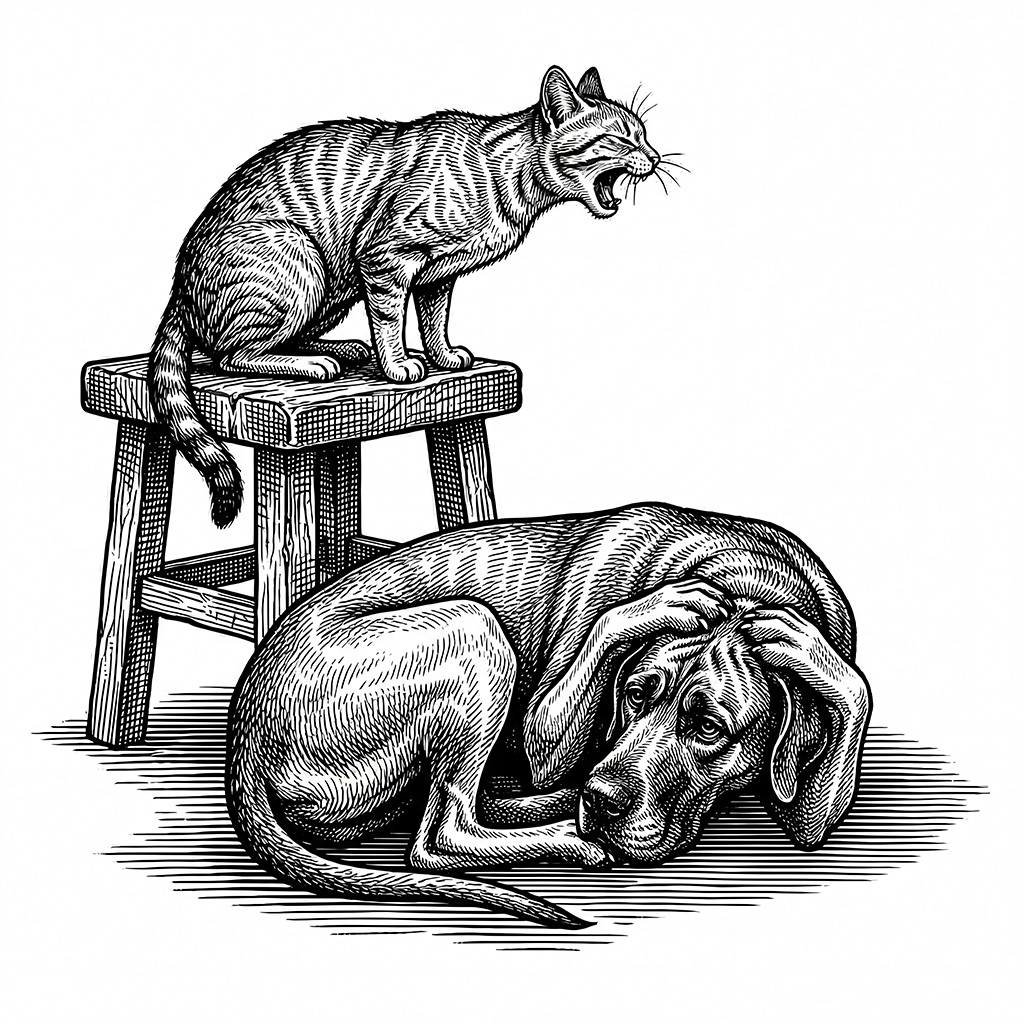
Illustrations – For the book I initially planned to compromise and aim for around 20 illustrations. This was less than ideal, but already seemed like more than I was going to be able to manage. However, if all goes according to plan, it will now have upward of 60. This has been the single biggest blocker for me over the last 10 months. I really wanted to use an illustrator for the book, and even more than that I ideally wanted to use a Dane due to some of the subject matter. This led me to explore a wide range of possibilities. There’s a very specific style that I settled on and have wanted since the beginning. Beyond that, the things being illustrated require a high level of interpretation and ideation. Keep in mind the earlier figure of $.50 per book. Now consider that if I were to pay an illustrator $1,000 (which would be the result of a collaboration / hybrid agreement and fall significantly under the $3000-45,000 career illustrators would charge) I’d need to sell more than 2,000 books just to cover the cost of my illustrations. Only about 10% of self-published books sell more than 1k copies (I still can’t believe Practical Curiosity broke 1k – THANK YOU AGAIN!). Only about 2% more than 5k copies.
While I have high hopes for my current project, that math left me in a pickle. Combine the complexity of what I want, and the specificity and my vision and I was stuck at a bit of a dead-end. Luckily, in recent months I’ve found a semi-palatable workaround: AI. It’s one that pains me as a photographer and creative, and yet it’s also a path to enabling me to proceed with my project. For the equivalent of about $170 I’ve generated somewhere around 600-800 image variants, of which I’ll eventually use around 65. To be frank, most of these are me fighting with the AI. But just as many are opportunities to draft, brainstorm, try different visualization ideas, iterate, and refine.
What has taken me 2 or so days of focus time would have taken months and months and countless iterations and thousands of dollars with an illustrator. I’ve also chosen a visual style that is more than a century retro in nature (no surprise right?), which means the AI training data used is much more likely to have been pulled from old manuscripts long since moved to the public domain and not be based heavily on the work of living artists. I’ve also gone out of my way to try and generate images that do not look like standard AI generations and which reflect my vision, ideation, and personal creative preference.
It does create a wealth of challenging questions. Especially depending on which cap I’m wearing. The author whose content has fed the machines? The photographer whose photos have also been exploited by the machines? Or the author now able to create something new, and stands empowered by those same machines. There’s a long and deep conversation that is still rapidly evolving around what ethical AI training looks like. For now though, I’ll focus on the creative piece – I see it as split into two different outcomes. The uniqueness and authenticity of a work vs. the illustrative utility of a work.
For the body of works where the uniqueness and authenticity is driving value the scarcity of the output, combined with the story and individuality of the creation and its creator, drive it’s value. This is true back through history. Why treasure a first-edition, or original manuscript, or Michelangelo vs. a perfect replica? In short, provenance matters.
In contrast, the illustrative utility of a work is of equal value, but for its illustrative power in supporting and facilitating the persuasive impact of other works. Here, provenance matters much less – or not at all. It is where something has become commoditized to support an experience. It is the printing press, it is anthologies, genres of art, stock photos, engineering sketches, stylistic toolsets, and training in the fundamentals. Where does this leave me and the book? Let’s see.
Is There a Path to Re-integration?
For the last few years I’ve written at length about the toxicity and intellectual banality of the likes of Rogan and Peterson. A common thread revolves around frustration with the disingenuous narratives that have driven policy and cultural narratives in the US. More recently I asked – if it was a different decade, who would they be? And now, with the historical record making it blatantly clear how accurate those critiques, concerns, and warnings were – there’s another question. What comes next and is there a path to re-integration and redemption for the individuals who have (for a wide range of reasons) facilitated such profound harm.
So, here’s the deal. For folks who got “red-pilled”, who voted for Trump this last time around and have now experienced or are at least starting to come to their senses and undergoing a wake-up call, here’s how you re-engage with people like me.
I didn’t end relationships because of a single vote. I did it because that vote and the conversations around it signaled a willingness to tolerate or rationalize conduct and policies fundamentally in breach of core values: honesty, empathy, integrity, accountability, democracy, and respect for others.
And more than that, it was often accompanied by a level of cognitive dissonance where the issues stopped being about principles and started being about finding a story that made it okay to support what you already wanted to support, what made you uncomfortable, or small inconveniences even when it meant excusing cruelty, corruption, or harm to others.
So, if you now feel betrayed by how things have unfolded, that matters. I’m glad you can see it now. I’m glad you’re waking up. But feeling let down by the outcome is not the same thing as examining what got you there in the first place. Regret over consequences is not the same as reflection about causes.
Just because the same bigotry, corruption, or indifference to harm eventually turned back and hurt you or those you care about, or because the promised benefits/opportunity never showed up, is not sufficient reason for me to reopen the door. That you now feel conned by what was, in many cases, a profoundly obvious con does not entitle you to instant absolution.
I do believe in redemption. I do believe people can reconnect with their better selves. But rebuilding trust requires more than saying, “I can’t believe I fell for that.” I need to fundamentally see that you understand and care about the impact of your actions on others. It requires confronting what you were willing to overlook, what rhetoric you excused, what harms you discounted, and how quickly stated principles gave way when they conflicted with team loyalty or perceived self-interest.
Because without that kind of introspection and accountability, the same pattern will repeat the next time someone comes along offering an easy answer, a scapegoat, or a benefit that comes at someone else’s expense. And if that work is not done, then yes – you have already shown me who you are and how you are likely to act when the next grifter or predator offers you permission and cover to be your worst self.
None of what has happened since November 5, 2024 should have been a surprise. We already knew who he was. We already knew what he had done. We already knew the people around him and what they stood for. This extends far beyond Trump and to the “Wellness” grifters, the red-pill podcast grifters, and the broader coalition of bigots and snakeoil peddlers.
Over the next couple of years, the narrative will shift to “Mistakes were made, it’s time we all move on.” And it will be the most disingenuous but often effective attempt to cover up, entrench the damage and harm that has been done, and quietly move the goalposts.
So when you see people demanding accountability and advocating for a culture where accountability actually matters, understand that is what needs to happen. Because that is the only path to correcting course and fixing what has been broken.
Iceland – There is Beauty in the Challenge
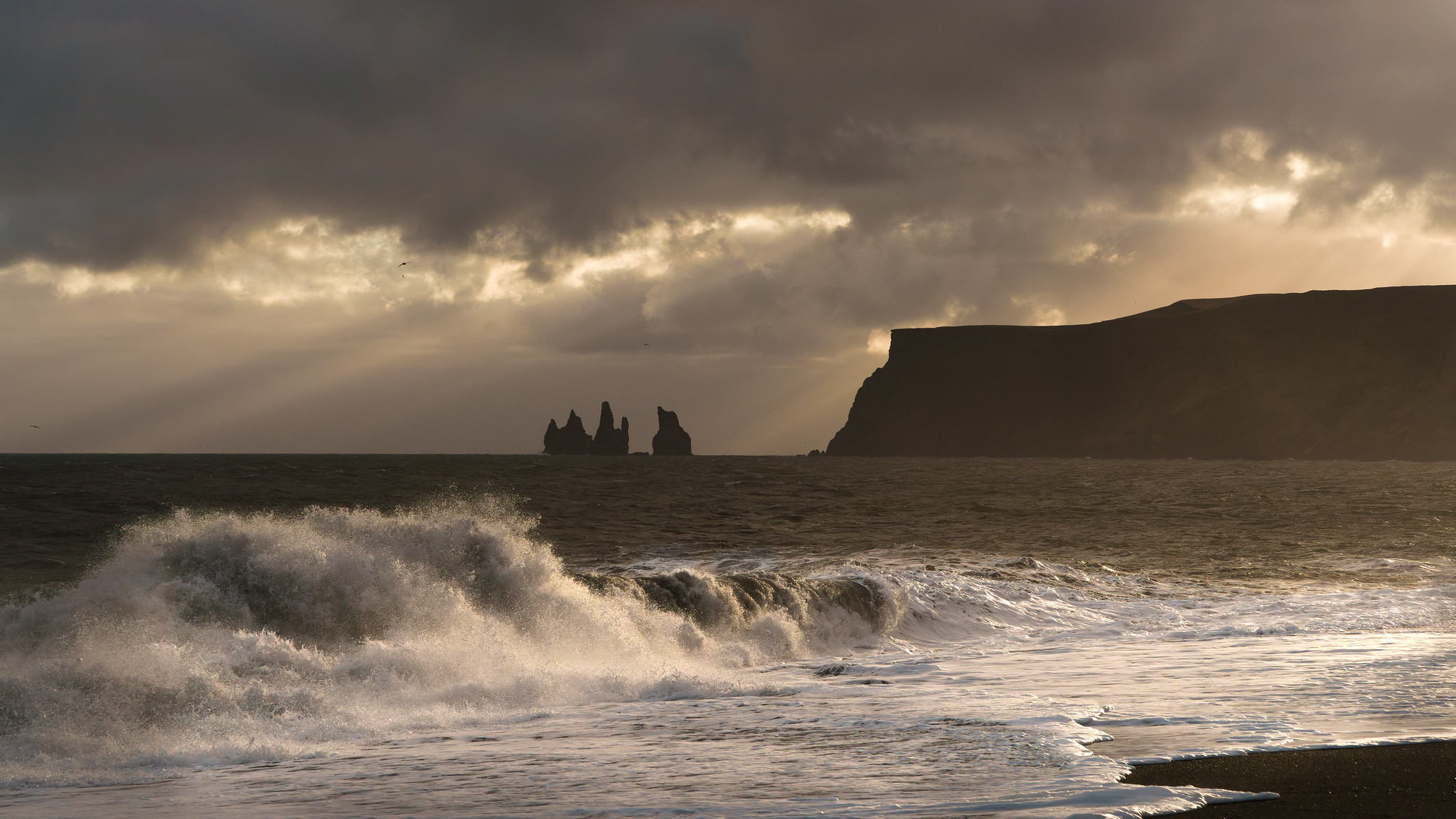
Last Easter I headed back to Iceland. The island always brings with it a blend of stunning beauty, challenging moments, and a glimpse into what the primordial earth might have looked like. I have to admit I booked this trip with some trepidation. Traveling to Iceland in late March/Early April can be … eventful. In just the past few weeks winter storms and flying stones stranded hundreds of tourists, with more than 20 having their windows and windshields broken by the blizzard. And whew, can Icelandic weather be tough. As dramatic as the landscapes are, the weather is ten fold. I’ll never forget the video from a few years ago of Brendan van Son and Greg Snell having to run out of their hotel in the midst of a blizzard to save their van because the wind was so strong it was slowly hopping the van sideways into another vehicle.
Luckily, I was spared the snow (though that would have been beautiful). I was also able to avoid the worst of the wind storms. Never the less, I faced quite a bit of rain, and 30m/s windstorms that rocked my car back and forth like a toy, and spun up dancing sea sprites lit by refracted rainbows across the bays.
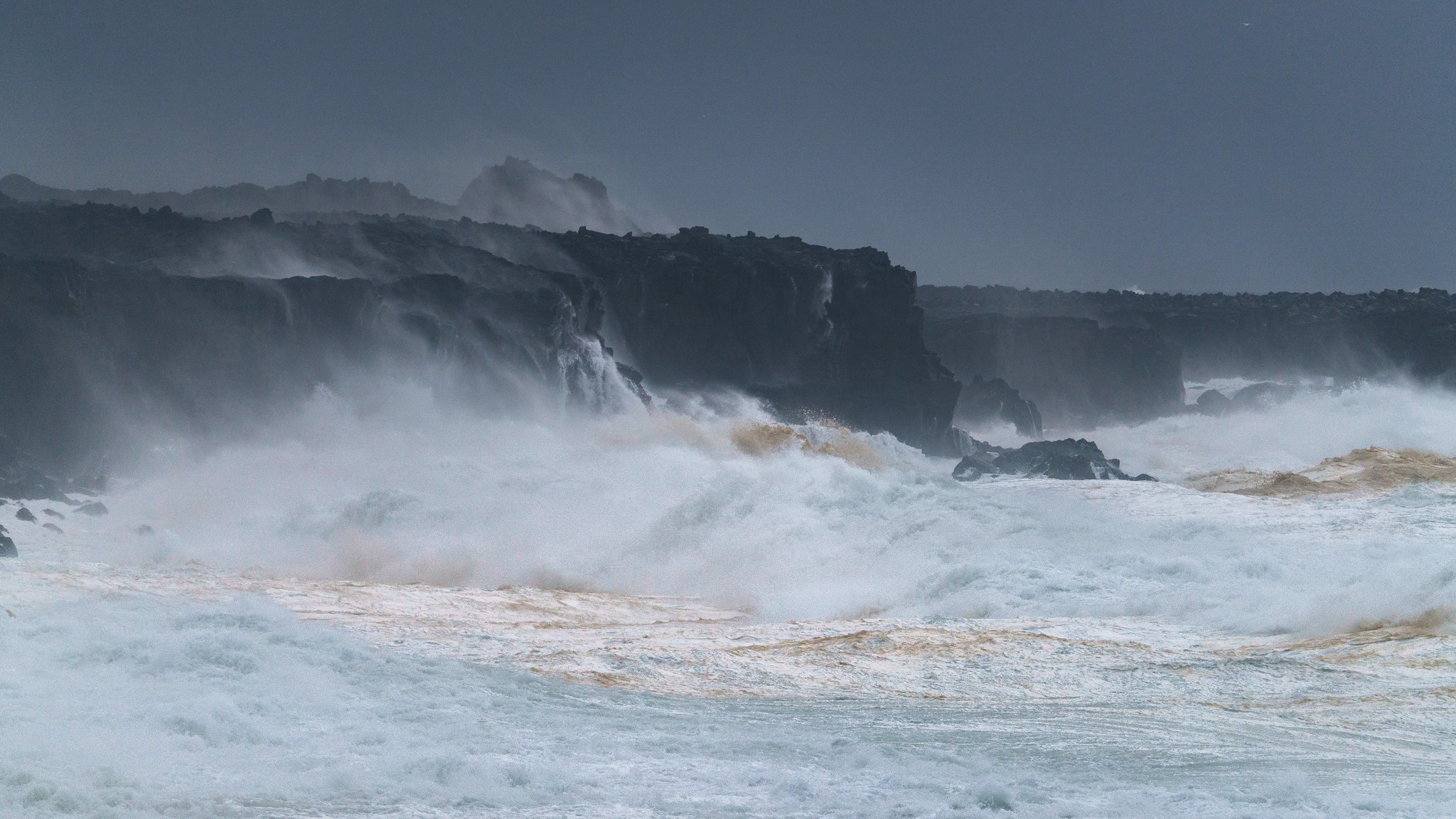
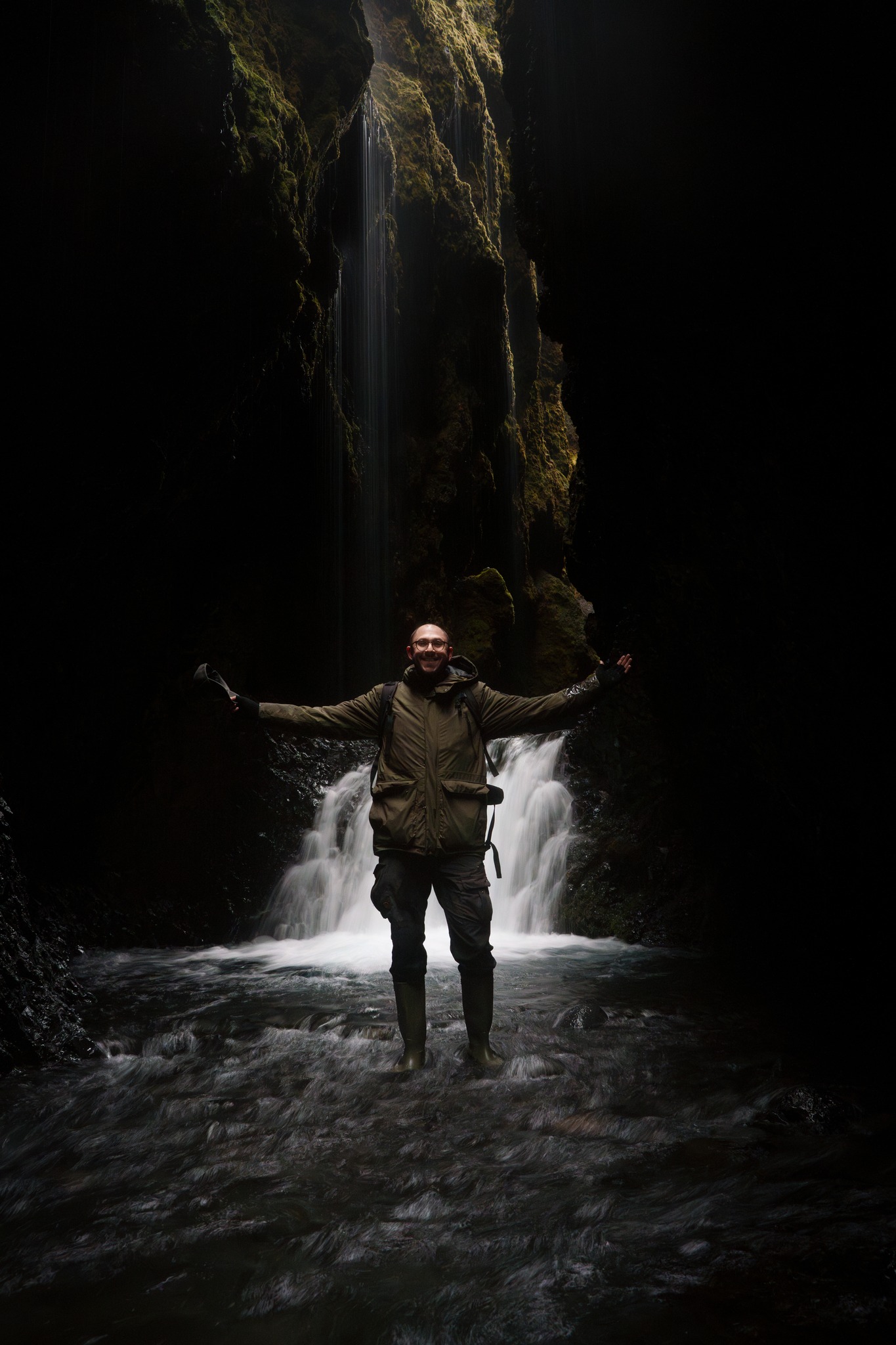
It was tough. But it was beautiful. And there was a fantastic sense of adventure in that, even while the realities of that adventure were extremely safe and mundane. While I was revisiting places I had been before, each change in the weather and time of year delivers wildly different experiences. Some, which I’d adored during previous visits, I had to abandon outright due to the wind. Others, I’d driven by or missed completely made for exciting new discoveries and magic moments.
While the weather did soften during some of the days, it did create a fun challenge that changed my behavior, encouraged me to innovate and adapt, and as a result opened up a range of fun new experiences.
You can see the photo albums from the trip in Color here, and in Black and white here.
Beyond that, I also continued to re-connect with my love of fishing. I had grand aspirations for fishing my way along the southern and eastern coast, catching grand cod from the shore, and cooking dinner while I sat out photographing the auroras. Whew. I got that wrong. I did catch fish (kinda, and eventually). I did photograph the auroras (repeatedly). I did not have a cook out or manage to combine these.
Gambling has never interested me. I’d rather watch paint dry. But, the thrill of fishing in the sea? It’s the gambler’s rush combined with a primal sense of connection with our ancient ancestors. As you set out, you brave the conditions, paying close attention to the wind, the tides, the moon, the flow of the water, the seaweed on the rocks, and 100 other small cues. You scout maps and then theorize what might be lurking out of sight. Then you cast out into that great unknown abyss teeming with life.
Cast after cast you chase the unknown, slipping into a meditative rhythm as minutes, or even hours slip by. And then? Often when your attention drifts and you’re least prepared, BOOM, a strike. Adrenaline surges through your body, your focus narrows in an instant as your primal and evolved brains wrestle for control.
How much force is too much? Where will I land it? What have I caught? And just like that – sometimes – it’s gone. Hours invested, and for not. Leaving you to wonder, if you’d reeled in differently, might you have landed it? What was it? Yet other times, you successfully land it – only to finally discover what “it” is. A Cod? A Mackerel? A Pollock? Perhaps. But I’ve also been surprised – I’ve caught several starfish, though how I could not tell you. Crabs of many different types and sizes and various seaweed anchored rocks. One buddy once even caught a random pair of men’s boxers.
So, how did my Icelandic experiment go? Well – it was largely a comical failure. At every opportunity I braved the freezing rain and wind and where possible found breakwaters and coastal inlets. I watched the tides and cast and cast into the frothy chocolate of the storm-tossed sea largely without success. And yet, I relished the challenge of it. The nudge to plunge back into the weather, and to turn my face toward the sea, tasting the salty mist on my lips, as I chased dinner.
Of course, Iceland did humor me. But, in a way that humbles which is – I suppose – fair enough. When I finally did catch a fish it largely came as a surprise. In reality, I didn’t even know I’d caught one until my spinner lifted free of the sea. Sure enough, a minnow with a very robust hunger and a level of optimism that is rather hard to imagine had gone for it and gotten hooked. To say it was an impressive feet is fair. Though, I must also admit it was perhaps the smallest fish I have ever caught on a spinner that size and certainly not the 60cm fish I was chasing.
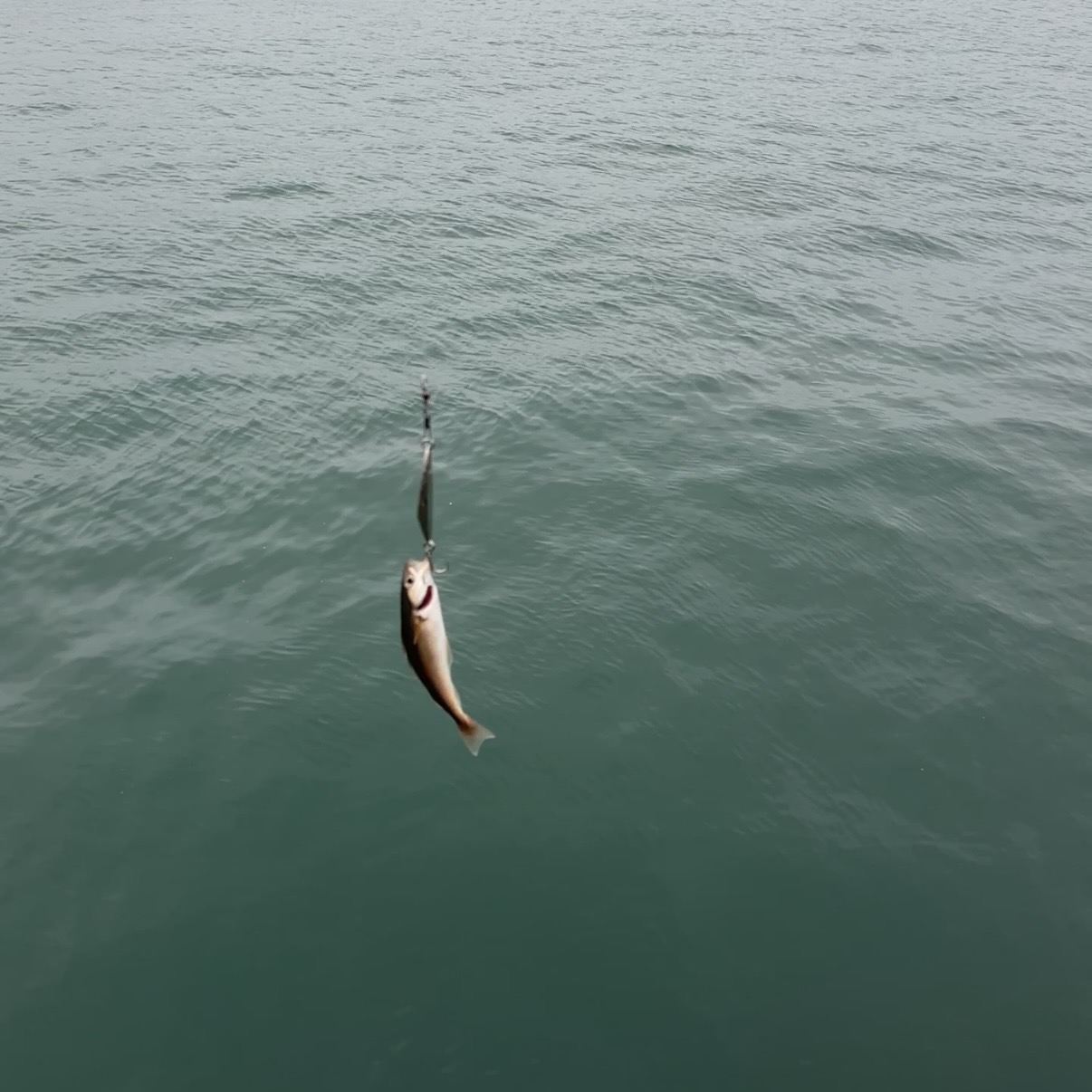
Still, I had to laugh. Sure enough, I had not gotten skunked. I had come to Iceland and I had caught a fish. And for that I was grateful. Humbled, but grateful. A little later that day, during another stop that found me hunkered on the lee side of a breakwater as the wind howled, I managed a few more that were several orders of magnitude larger – but still far from ready for dinner.
All of which is to say, that even with all the challenges that came with my trip to Iceland, I loved every moment of it. It was challenge after challenge, and yet that was part of the beauty and part of the pleasure.

China and Taiwan – Interesting Contrasts
This year provided another opportunity to revisit China, but with an exciting twist. I rounded out my trip with my first visit to Taiwan, and closed the trip with 24 hours to explore and test assumptions in Qatar.
The China Leg
I’m fascinated by China and the contrasts it provides as well as just how fast it is changing. Since my brother and I first visited in 2017, I’ve been back a number of times and each time is a delightful adventure. One that challenges me and continues to debunk and erode stereotypes while filling my belly and camera roll.
The digitization and infrastructure improvements in China are shocking. When we first visited, communication was viable via our phones, but often people would refuse to engage. Getting cash from an ATM was periodically challenging, and logistics were ok but could be daunting.
For this trip? Anything but.
I started my trip in a new city with the sum of my plan consisting of my flight from CPH into Chongqing, and a flight home from Taiwan by way of Qatar 3 weeks later. Why Chongqing? It was the cheapest and best route from Europe. But, later, I also learned it was far more than just the 4 or 5 million person regional city I had thought it was.
Oh no – it is far far more than that. As it turns out, though it has spent decades out of the limelight and only recently started to pop up as a major global tourist destination – the city is enormous and has a rich history. 3 or 4 million residents? *laugh* try 22 million in the city and 32 million in the immediate region. That’s not a typo.
The city itself is fascinating. The war-time capital of China, it has served as a major trade hub for centuries, is famous for its Sichuan pepper-filled dishes and hot pots, and has countless skyscrapers built on steep cliffs and into hillsides. The result is a wild mixture of floors, stairways, roads, and bridges that take you from ground floor across to the top floor of 30 story buildings. The city is also famous for its drone shows over the harbor, a metro station in the middle of a building, and it’s cyberpunk style neon-lights. Oh, and of course, Pandas. I won’t go into specifics here, but reading the Wikipedia page for Chongqing is well worth it.
I am fascinated by the realities of a city like this. As you thread through the zig-zag of streets, most of the buildings show new construction and flashy facades. But, this city has been building and reinventing itself for decades. When you wind past older buildings, you find ground-floor mall spaces that are at times half occupied. Abandoned floors, nestled between bustling hotel levels, restaurants, and retail spaces.
Supporting it all are cement and steel foundations that are powerfully built, but hint that over time age will continue to chip away at them. Bit by bit. There, I can’t help but wonder – what do you do in a city of skyscrapers, scratched into the side of cliffs, as they begin to age or fail? 30, 50, or 100 years from now – what happens to these buildings and how are they replaced, or restored? It’s a question that I suspect is only asked in muted whispers and the answer is largely yet to be truly figured out. Will these become weather worn white bones exposed to the elements. Scars threaded in among the new? Or will they be incorporated, de-constructed just as they were constructed, and replaced by something even grander?
Regardless, I found the city welcoming, hospitable, and fascinating to explore. From stumbling into an open air market with chickens wandering freely, a vibrant range of fruit and veg on display, and fresh fish in aerated kiddie pools in the basement of one skyscraper to a pet fish market with marble floors, immaculate tanks, and massive fish of every color in another.
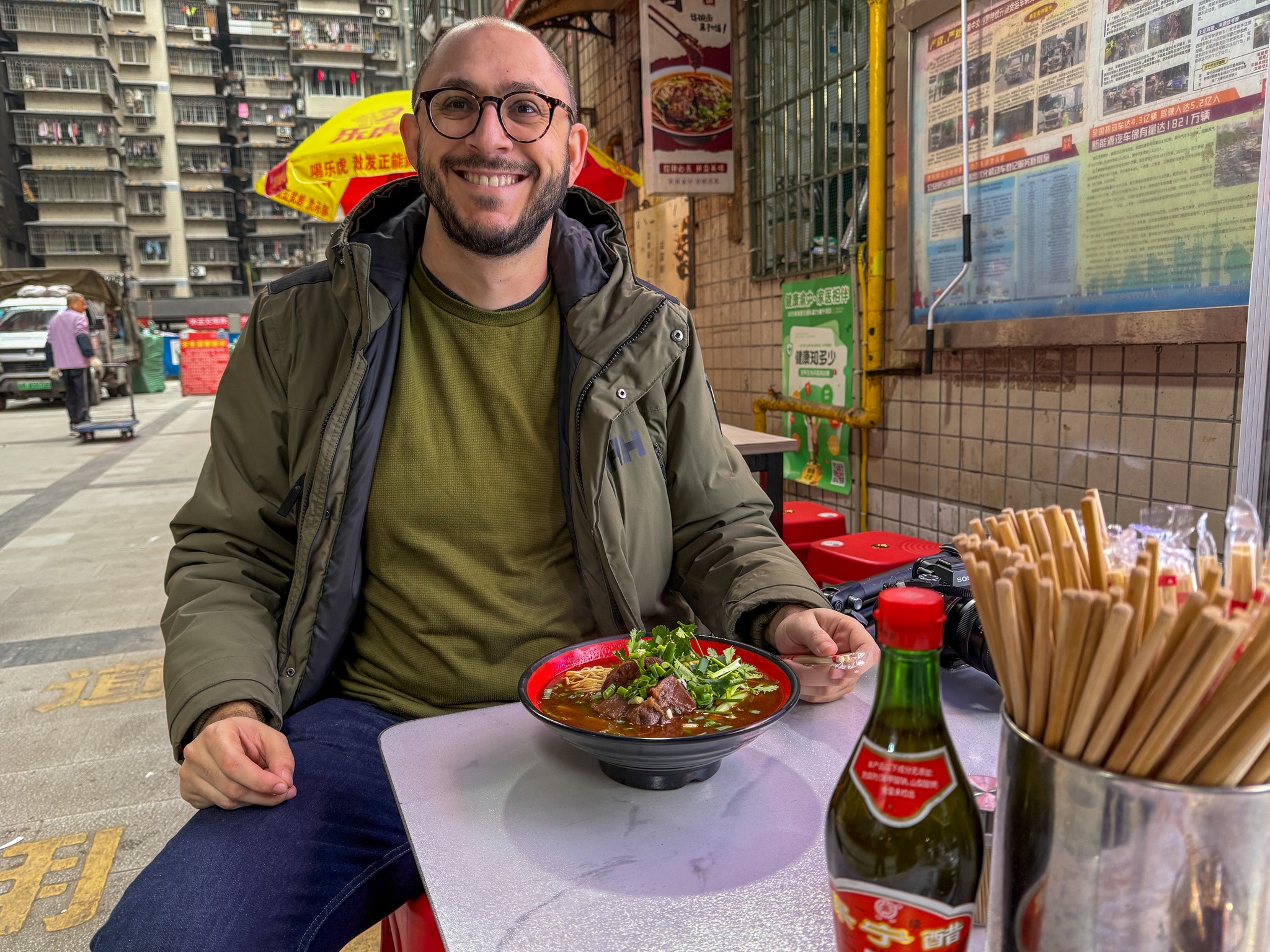
Far too often people worry that people will be unfriendly or unkind. And yet, time and time and time again, no matter where I go I rarely find it. Even in large cities. Especially when you stray from the throngs of tourists and cookie cutter stands. Quite the opposite, at every turn someone was as curious about me as I am about them. Eager to help me explore whatever random dish I’d stumbled into ordering, or gifting me local candy from their shop that they insisted I try.
Technology is a great liberator when it comes to exploring such places. I mentioned earlier my past issues with finding ATMs and cash. This trip, in the two and a half weeks I spent in Chongqing, Zhangjiajie, Huangshan, and Xiamen I never needed cash once. Between AliPay and WePay, everything from cheap dumplings to my hotels and airfare were paid for digitally. Trip.com made it painless to find and book hotels, trains and flights while the Chinese Didi app – their version of Uber – made it cheap, safe, and wonderfully convenient to get around. Prices also offer a wonderful level of freedom. A 15 minute taxi ride might cost $8. A 50 minute taxi from the train station to the north gate of Zhangjiajie National Park? $25. And to tie it all together, Wechat’s built in translation tools, alongside my downloaded translation apps made communicating wonderfully accessible and convenient. Interestingly, there was also no need to use my VPN. While I’ve had excellent results with the Mullvad VPN and the price is far superior to alternatives, I was able to use my phone and internet as normal via my Danish roaming package. As it turns out, at least these days, the network pings and re-directs to Europe directly. Which meant it bypassed the usual blocking and limitations that, if connecting via a local SIM or wifi, can create logistical challenges.
Plus, it is safe and has only gotten safer. As one individual I spoke with noted – in the last 5 years, the vast majority of crime has been eliminated. While some obviously still takes place, wandering the cities, even at night is of zero concern. Of course, that also comes with a cost and considerable risk of its own. That safety comes from a robust surveillance state that permeates everything. While I don’t know the accuracy, one individual told me the country has a 1×1 km grid laid over it and there’s at least 1 cop every grid. In other cases, if you jay-walk or run a red light, the ticket arrives in your digital inbox before you’ve reached the next light. Tickets at the train stations or national parks are now also increasingly replaced by simply scanning your face and passport.
It is an interesting experience, as it highlights a fundamentally different approach from the western world. But, it also simultaneously illustrates many of the services or data that are similarly accessible and pooled in the US and Europe, but hidden behind privacy performance theater. The question then becomes, how much inefficiency do you want to add as a feature vs. a bug, how much actual privacy exists vs. the illusion of privacy, and what is the threshold we are comfortable with for convenience, safety, and integration vs. total loss of privacy and control.
The part about seeing the Chinese model in play that is fascinating, is seeing just how well it works and the utility it delivers right now. And yet, that only extends to those who aren’t part of a minority group, who aren’t being silenced or persecuted, and who rely as a contented majority on a relatively competent and benevolent leader. With the flip of a switch, all of those benefits could be inverted and suddenly become tools supporting corruption, driving exploitation, and squashing dissent. It’s an incredibly useful tool to reflect on and apply to my own day-to-day life here in Denmark, and my ties to the US.
And what of the rest of the trip? I revisited the incredible spires of Zhangjiajie National Park and Tianmen Mountain. This time, I was able to actually stay inside the national park at a lovely little homestay for 35 euro a night. It had a fantastic morning view where I could watch the sun rise over the spires and meant I could stay for sunset at the overlooks without having to run to the last cable car (or risk getting stuck as nearly happened to David and me years ago).
From there it was back to Huangshan Mountain, where I spent several days at the hotel on top of the mountain. Truly it is a magnificent place. Sure enough, I also got lucky with snow the final day – exactly what I had hoped for.
I finished my time in China with another new city: Xiamen. This coastal gem is famous for being one of the old trading ports. The small car-free island in the heart of the city is a UNESCO heritage site, and full of old colonial era dwellings. The city of Xiamen itself was a cozy place to sit, wander, and eat. Then to eat a bit more. And then to eat even more. I had previously planned to spend New Years in Taiwan, but ultimately the prices in Taipei and room availability were radically more expensive than Xiamen and, to complicate things further China carried out a massive military exercise surrounding Taiwan. Luckily, I did not have my flights booked and could wait until things ended and calmed down. Though a bit nerve wracking, I ultimately figured since I was flying a Chinese airline between the two, flights would not take place if things spiraled. Sure enough, I had a lovely calm New Years and then was able to continue my journey to explore Taiwan.
The Taiwanese Leg
I started my Taiwanese visit in the most comical way. Now, let me preface this by saying that I have only missed one flight in my life. And, I very rarely show up at the wrong airport or the wrong day (there was a ferry incident, and the time I booked two one-way tickets CPH to Scotland instead of there and back again – but let’s not go into that). Having said that, I landed in Taipei, made it through immigration, and then found myself standing in the arrivals terminal trying to find the MRT. A bit baffled as I was seeing metro signs, but no MRT was mentioned. I eventually cracked and asked the information counter.
She paused for a second, and then somehow – and I truly don’t know how – informed me that the MRT only goes to the other airport and that I had arrived at Taipei Songshan Airport, NOT Taiwan Taoyuan Airport. Now, other than being rather embarrassed, this actually worked out wonderfully as Songshan is located in the heart of Taipei, while Taoyuan is quite some ways outside of the city. So, failing – forward? I guess?
Unfortunately, my earlier aspirations to explore more of Taiwan had been cut short by the NYE prices/geopolitical issues. That left me with two brief days to explore Taipei. Far too few to wander into the mountains and see the true beauty everyone raves about, or to explore the far eastern coast as I’d previously hoped. Everyone said that while Taipei offered a distinct modern experience, Kaohsiung in the south was where the historical buildings and historic Taiwanese charm was strongest. To that end, I feel like my brief visit was just the most basic of tasting tours, nothing more.
Right off the bat it felt similar in some ways to Xiamen which is about 200 miles west across the straight, and yet the contrasts were definitely significant. Taipei reminded me in many subtle ways of a grittier taste of parts of Japan or Korea more than China. That’s a broad generalization, but as I tried to make sense of things and relate it to what I’d previously seen that was the sense I got. Truly, it felt like a mixing pot, blending all and adding its own rich and unique history on top.
While the city was vibrant, it was an immediate challenge as I struggled to navigate a meal and payment without being forced to take out cash. Most of the small mom and pop shops were cash-only, while even the metro was just in the process (a few weeks after my visit apparently) of digitizing payment. This definitely made it clear that Taipei at least is a city in transition. A high tech, and thriving innovative city, that still has not fully made the jump to digital-first.
As I walked around over the next two days, taking in the sites, and adjusting to hearing much more English around me once again, it was fun to see. On the metro and at random there were many more spontaneous conversations. Sometimes locals, but often members of the Taiwanese American or Canadian Diaspora. As I watched and listened, I could see groups – often the grandparents who I presume had immigrated to the US, with their kids and their kids in tow visiting and re-connecting with Taiwan. While far from “everywhere” it was a regular enough occurrence that it caught my eye.
The first day was dedicated to exploring temples, visiting a few museums, and just wandering the city. Exploring the grand monuments, and boulevards and winding through small cozy street markets and old temples. For the second, I wanted to see something beyond just the historic core, so I caught the metro to the end of the red line which took me out near the coast. From there I had a lovely walk along a boardwalk full of food stands and people, threaded through a great raw street market in a back alley that stretched for a good km, and ate, and ate, and wandered, and ate.
One thing that really stood out to me, was how much more Taiwan felt like and reminded me of American “Chinatowns” than what I’d seen and experienced in China. It’s hard for me to put a finger on it, but in a wealth of subtle ways, from the feel of the temples, to the old districts still left standing, to some of the dishes, to the lunchtime buffets – Taipei felt much more familiar.
I’m not sure where that comes from. In part, when China went through its cultural revolution, they had an extended period where they erased much of their history, architecture, art, and so much more. And while in the last 30 or so years they’ve made a concerted effort to re-build, recover, and re-create some of that in recent years via Ancient Towns and lots of construction – you can definitely see and feel the absence. For Taiwan, much of that never took place. Quite the opposite. Those seeking to preserve some of that art and history instead relocated it to Taiwan.
I cannot begin to pretend I have the slightest insight into the nuances between the two and their incredibly complex history. What is clear, is that 150 years ago the two diverged in a significant way and have evolved along very unique trajectories which have remained somewhat connected due to trade and proximity over the years but which remain profoundly distinct.
As much as I enjoyed Taiwan, the absolute highlight was a bit of a surprise. Some 20 years ago at Arizona State I lived in a 4 bedroom apartment with two of my best buddies from high school. In the 4th room several international students lived while doing English Language programs. Tim joined us for about 9 months and so – when I knew I was heading to Taiwan I dropped him a note. I’d initially hoped I’d have time to travel around, and then find my way down to the city where he’s living. But, as time compressed, I didn’t think I’d manage to make it. I was bummed, to be so close, especially after 20 years, but not to get to catch up was a major pity.
Fast forward to 5pm on my last day. I open my messages and see “Don’t eat. I’m coming -I’ll be there in an hour and a half.” – wait, what I thought? Sure enough, an hour and a half later there he was. Tim had jumped the high-speed rail and come up to Taipei. To say I was touched is an understatement.
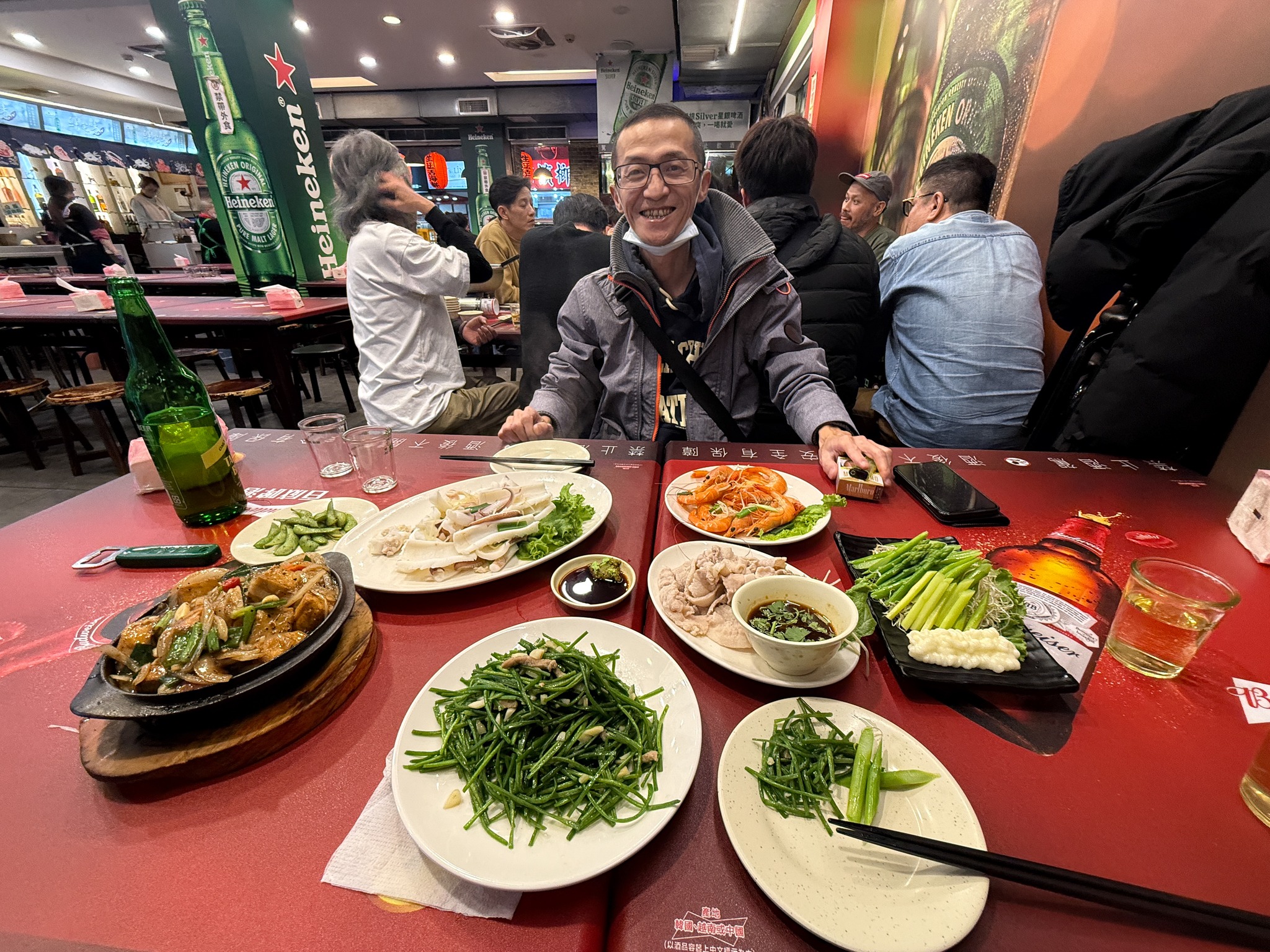
He grabbed me, told me to follow, and we jumped in a taxi to a different part of Taipei. As we rode along we caught up on life, stories, and 20 years – filling in some of the gaps. The restaurant he’d chosen was an open air place with an amazing mix of fresh dishes and amazing eats. Even as I limped along nursing a bit of a grumbling tummy due to a particularly ill advised fried crab purchased in the alley-market from a street vendor – the mixture and flavors of the food brought my hunger back. From there, it was off to another district to meet another of Tim’s friends. A wonderful creative kind soul who joined us for a drink and a chat far later into the evening than I had planned.
From there, it was eventually back to the hotel where I said goodbye and goodnight. I’d thought Tim was off to catch the night bus back to the south. I got myself ready to head to the airport in the morning, digested the food, and the warmth of the hospitality and kindness he’d shared. By about 1:30 I switched off the lights and turned in. At 7:30 I startled awake when the phone in the room rang. Worried I’d overslept I answered groggily. “Your friend is here to take you for breakfast”. Dazed it took me a second. Then I realized Tim was back to show me a bit more of the city and to make sure I had a proper Taiwanese breakfast before I headed to the airport. I jumped out of bed, threw on some clothes, and headed down. Sure enough, though my normal pre-flight routine was disrupted, we had a lovely hour and a half walk through the area, got to catch up more, before I finally had to say until goodbye until next time once again. I grabbed my bags and headed to the airport. This time taking the MRT to the right airport.
I’m still so touched by Tim’s hospitality. What a gift of time, and effort and showing up. He has forever created a warm association for me with all things Taiwan and made my brief visit very memorable. A lovely reminder for us all on just how much it can mean to make that extra effort.
From there, it was off to the airport and on to Qatar.
The Qatari Biryani Layover
I know that Qatar and the UAE are not destinations that have a strong draw for me. For many people, they’re incredible places to live, visit, or transit through. Based on how much I adore Oman, there is probably an experience for me to be had outside Dubai or Doha, but in general I’ve now confirmed my lack of interest in the big cities.
I’ll be brutally honest. I was pretty sure Doha wasn’t going to be a city I fell in love with, but 24 hours of hot sunny weather, the chance to get a taste of a new country, and a strong desire for a couple really good Biryanis was the extent of my plan. A day in Doha was certainly enough for me. I got my Biryani and was delighted with that. I had a good wander, enjoyed sitting in the sun soaking up some heat before returning to Copenhagen, and thoroughly enjoyed a stop at the Museum of Islamic art which was home to beautiful exhibits, interesting history, and stunning architecture.
Beyond that? I’m all set.
Final Thoughts
It’s 1:45am, and I have a flight to the Norwegian fjords for the next 7 days leaving in 10 hours so – I’ll keep this last bit brief this year.
Thank you. Thank you all for your support. For humoring me. For supporting me. For your feedback, for your passion, for your knowledge, and for your patience.
There are so many of you I owe coffee chats with, and don’t talk to or see nearly often enough. As the days race by and work obligations eat a larger and larger portion of my time and energy, the part I am most conscious of is how that consumes my social battery. As an introvert, recharging it and maintaining balance is hard. One of my goals in the year ahead is to protect more energy for it, to spend more time catching up, and to be more available.
Until then, thank you to each and every one of you who made it through part (or all) of this 14,000 word brain dump, ramble, and mixture of musings.
Until next year, may the roads open up for you.