Introducing The Essential Book of Danish Sayings
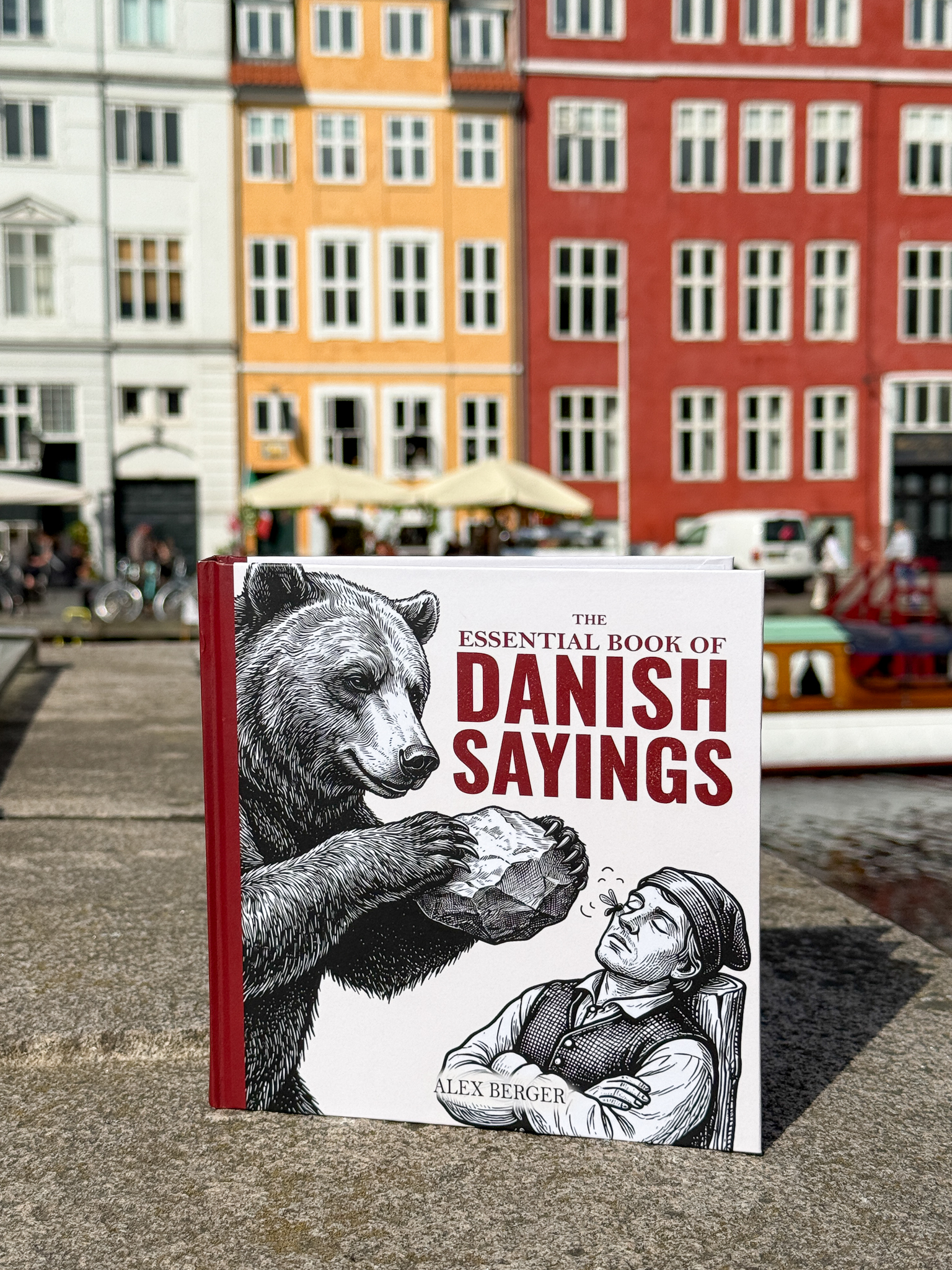
I am thrilled to announce that my latest project is now live in both Hardcover and Paperback. You can find the official webpage at Danishsayings.com. In total, the book contains 167 Danish sayings, of which 65 are illustrated in a visual style that seeks to balance Danish simplicity, a sense of tradition, and the playfulness of the sayings.
As an international living in Denmark, conversations around cultural sayings, slang, and idioms come up fairly regularly. I’ve always loved cultural sayings as they capture the shared wisdom of a society but also contain fascinating insights into how that society has evolved, thinks, and what it values. There is also often a sense of earnestness that comes with a well-used idiom or proverb. While those conversations often start with questions about an American saying or idiom I’ve used, they often quickly evolve into trying to find a comparison in Danish. Just as often it’s a Danish friend attempting to translate a unique Danish saying into English. Over the years I’ve always found this to be a rich topic of conversation and a delightful glimpse into Danish culture.
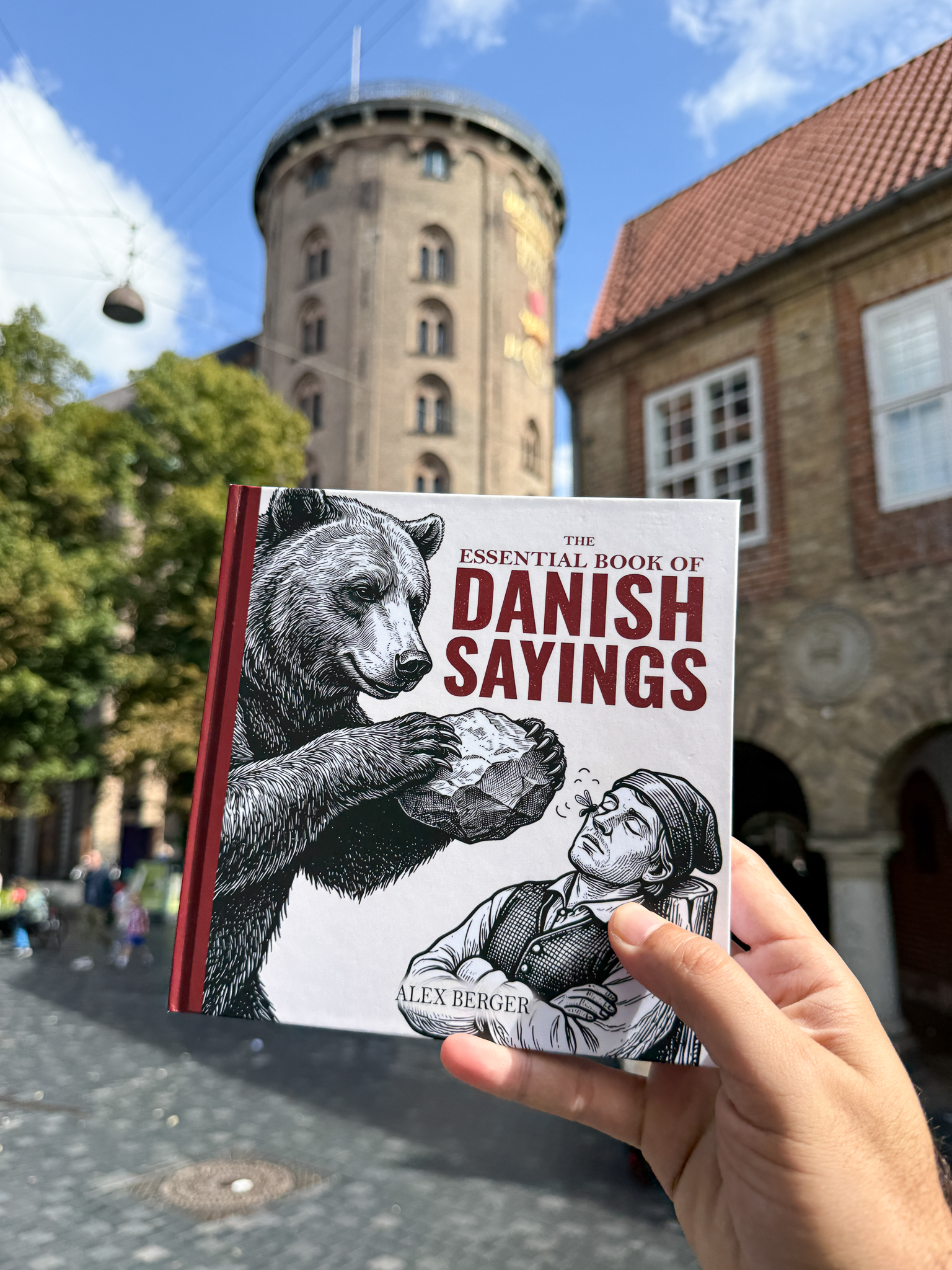
The Essential Book of Danish Sayings is a 17x17cm (6.7×6.7 inch) square format in both hard and soft cover. Designed as a compact coffee-table book, it is comfortably sized for gifting or carrying home as a travel keepsake that reflects Denmark in a richer way than many traditional souvenirs.
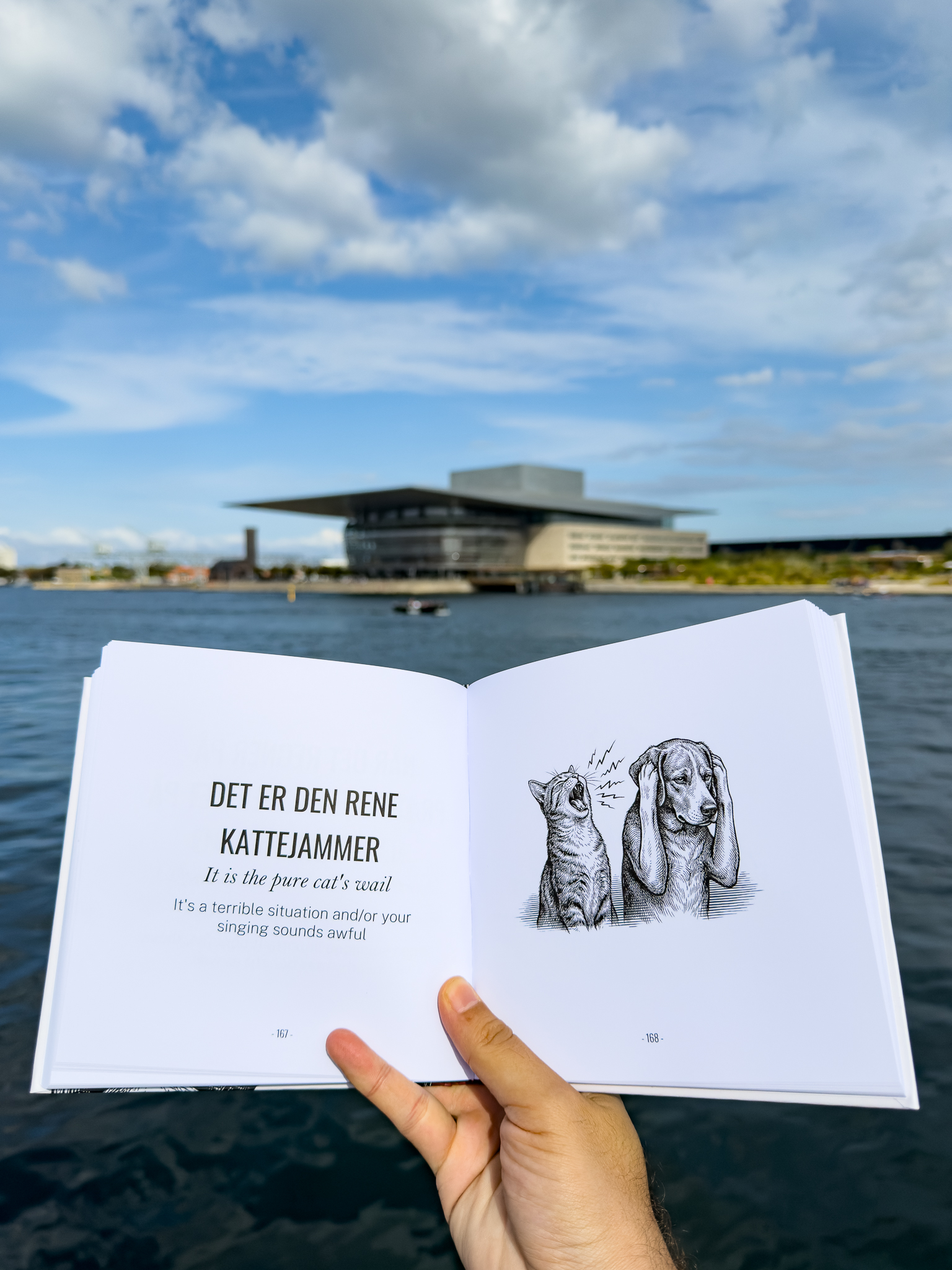
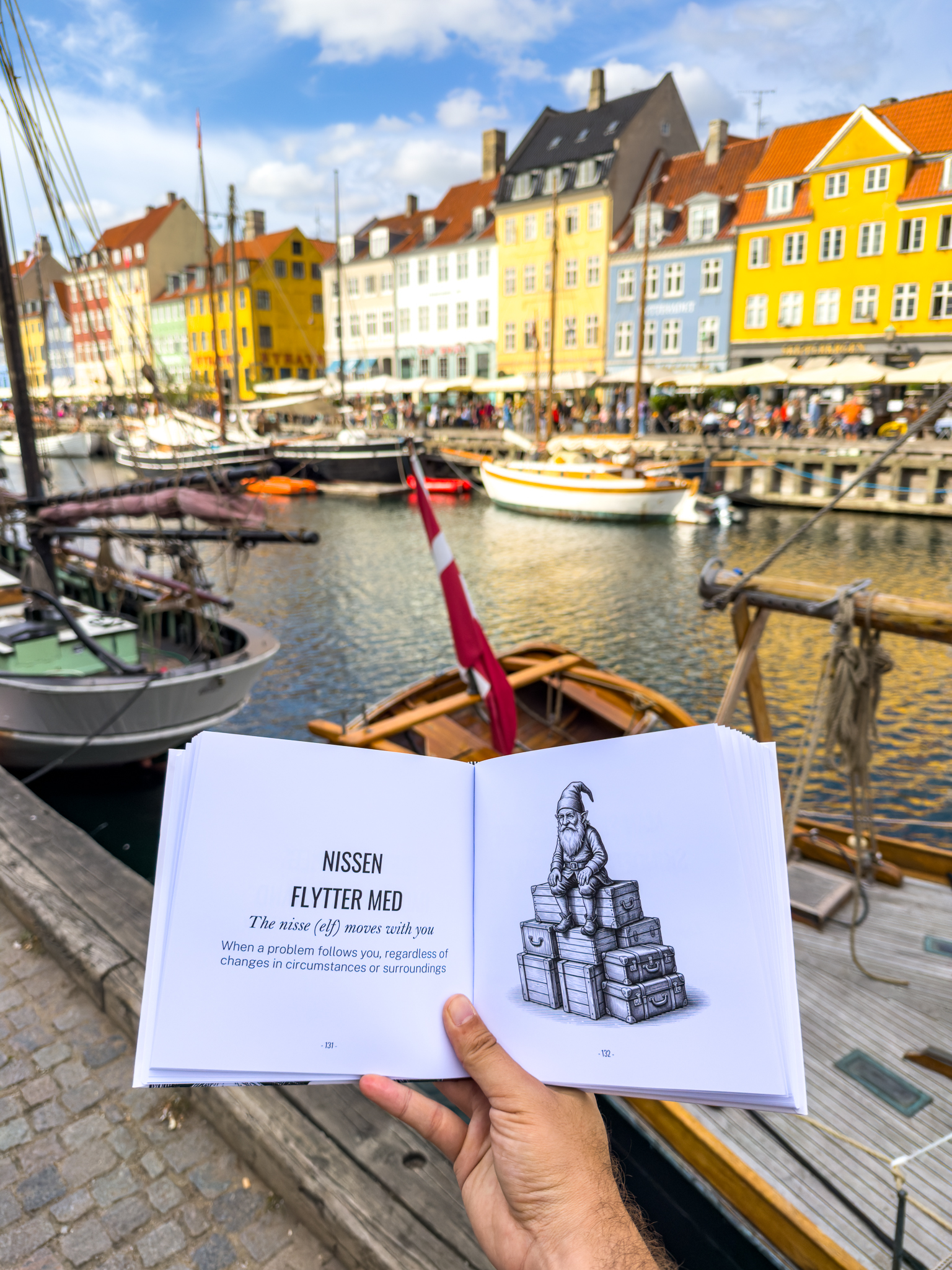
Each saying is presented in its Danish form, followed by a direct English translation and the general meaning of the saying in English. Part of the charm and character of these sayings is how different they can be from anything we have in English or (where there is one) their English counterpart.
I’m sharing and posting some excerpts from the book on Instagram: @EssentialDanishSayings and Tiktok: @EssentialDanishSayings.
Where to Buy It
Retail Price:
- 280 DKK for the Hardcover
- 189 DKK for the Softcover
Geography:
- Online availability in the Nordics/Europe.
- Global distribution limited due to using a Danish/German publisher (working on a solution).
Online retailers:
Bog & idé – Hardcover (280 DKK) | Softcover (coming this week)
Saxo.dk – Hardcover (255 DKK for members, with free shipping) | Softcover (coming this week)
Amazon.de – Hardcover (37.35 Euro) | Softcover (coming this week)
BoD Bogshop – Hardcover (280 DKK) | Softcover (coming this week)
Brick-and-Mortar Bookshops:
Over the coming months, I’m working hard to pitch bookshops, museums, and the like. I’ll update this list as I can.
The success of a project like this is shaped almost entirely by three initial influences: word of mouth, ratings, and reviews. It is difficult to put into words just how impactful each is, and how significant a role they play in making a creative project discoverable. While normally artists and authors prefer the opportunity to sell directly, cutting out intermediaries – in a case like this book – it’s incredibly important that the platforms that amplify distribution see interest in the book, ratings, and reviews. For that reason, even though it means 33% fewer DKK reach me per book, I greatly appreciate you using one of the platforms.
Why Danish Sayings?
The topic of idiomatic sayings as a window into understanding a culture often surfaces within international circles, particularly among students relocating to Denmark. Over the years I’ve met very few people who weren’t animated by cultural sayings, curious which they already know, and eager to discover new ones. Sayings like Det blæser en halv pelikan – It’s blowing half a pelican, or Ananas i egen juice – A pineapple in its own juice are celebrated for their quirky delightfulness. For me, this has been like catnip feeding my own fascination with the underlying what and why that shapes Danish culture. They’re also just a ton of fun to explore.
On a walk home one day, after having one such conversation, this led me to a fun idea – what better gift, keepsake, and idea than to create a playful, visually attractive, clean book of Danish sayings. A quick search showed that, for whatever reason, there seemed to be a gap in the existing literature. Even more than that, there wasn’t any attempt to really showcase and bring to life many of these sayings in a fun, playful, and accessible way.
So, I set out on a 2.5 year journey to gather, validate, refine, and illustrate some of the most popular, interesting, and thought-provoking Danish sayings.
Fun Insights Along the Way
In addition to discovering many entirely new (to me) sayings, there were others which came with interesting nuance which I found delightful.
In the US, we’ll often say – It’s better to have a bird in the hand than two in the bush as a way to convey the importance of valuing what you have vs. what you might have. In Denmark, it’s very similar, but with a subtle difference. Here, it’s not two in the bush, it’s ten on the roof.
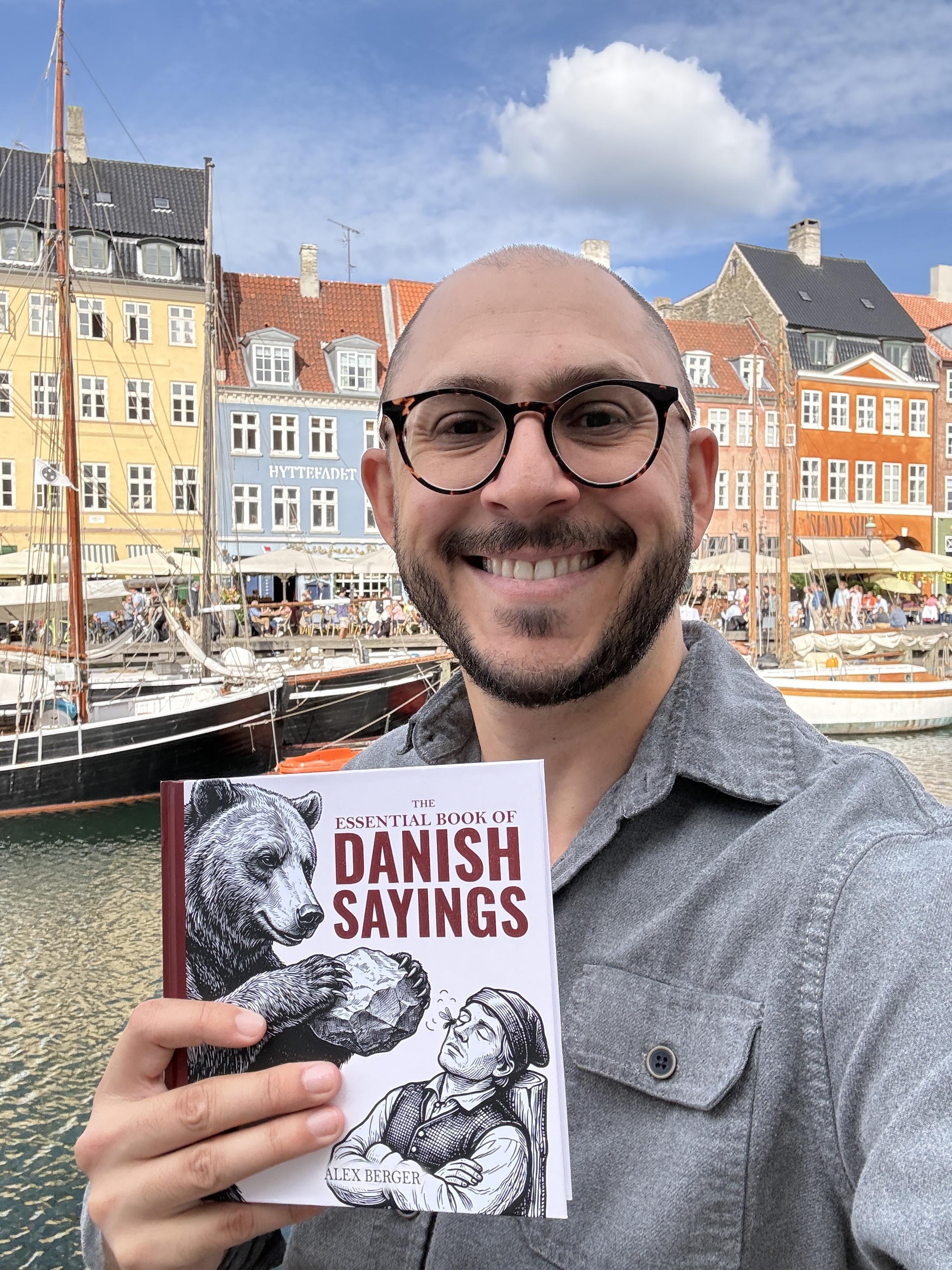
Another area has been just how dramatically a saying’s meaning can change over time. The book’s cover features a bear looming over a napping man. That man has a fly on his face, while the bear holds a rock over him. But, the bear in this instance doesn’t hold any malicious intent for the man – quite the opposite. He’s about to do the man a bear favor. In Danish At gøre nogen en bjørnetjeneste – To do someone a bear favor – has historically meant to do a favor which is not actually a favor at all. In the case of the cover? A bear swatting a fly on the man’s face with a rock. Well-intentioned? Absolutely. Disastrously unhelpful? Also, absolutely. And yet, this saying has also had its meaning evolve in recent years as subsequent generations have misunderstood the meaning. What does it mean to do someone a bear favor? Ask young Danes and many might tell you, it means to do someone a big favor. One that is so big, it’s bear-sized. Just like that, the meaning has flipped 180 degrees.
Thank You
If you’re reading this, then you’re part of the journey of bringing this book to life and helping it bring joy to more people. Thank you for your interest in the project and supporting it in whichever way possible – be it simply spreading the word, picking up a copy of the book, leaving a review, adding it to your want-to-read list, or even just taking the time to read this post and be curious about it.
I also want to take a moment to say thank you to everyone who has helped me during the creation and brainstorming stage of this book. To the Danish friends who have reviewed and proofed my lists of sayings, suggested new ones, and helped me fine-tune the meaning for each saying to ensure I properly capture the essence in my translation. To the international friends who have been supportive, sparring partners, and lent a patient ear.
Common Questions
What are the differences between the Hardcover and Softcover?
The two are identical content-wise. The only difference is the structural format of the cover. I personally adore the feel of a hardcover, and think it changes the entire feeling of flipping through a book like this. However, both versions are otherwise identical.
Why did you choose the 17×17 format and size?
For me, having a very clean and digestible layout was a core part of the vision from day one. I wanted to be faithful to Danish design and a degree of the clean minimalism that Scandinavian design has become famous for. I also wanted a design that would handle pure text as well as text + illustrated sayings equally well. I initially experimented with slightly larger square designs, but eventually felt the 17×17 sizing both visually felt best, and was also a far more attractive size for tourists or visitors who would need to fit it into their luggage. So, the end goal was not to compromise on the look and feel, while creating a book that was equally at home on your coffee table and in your luggage.
Who do you hope the book is relevant for?
I believe the book is relevant for Danes and non-Danes alike. For Danes, I hope it is seen as a celebration of cultural language, the chance to discover one or two they’ve forgotten, and to see their sayings through a new lens. I also hope they believe in the quality of the book enough to make it a staple gift to foreign visitors and friends. However, I see the primary audience as visitors to Denmark who are eager to get a keepsake that is more unique than more traditional tourist keepsakes. My goal is to have the book distributed through everything from standard bookstores and museum shops, tourist shops, airport stores, international schools, language schools, and even cafes or hotels.
What ages is the book targeted at?
This will depend on your cultural and individual views. I wanted to capture a full cross-section of Danish sayings. As a result, sayings including profanity such as Flueknepperi – Flyfucking, and alcohol such as At have en bjørn på – To have a bear on (to be very drunk) are included.
Who did the illustrations?
My initial vision included using a Danish illustrator to bring 20 of the sayings to life in the woodcut/etching inspired visual style I wanted. I spent more than a year having conversations with various artists, while trying to find a way that would work. Ultimately, this was not viable for several reasons. First, this book has been created on a tight budget. I have not had thousands (or tens of thousands) of DKK/USD to commission original work in the style I wanted.
Second, I had a specific visual style and vision which I wanted, and was unable to find an artist specializing in it with the wide range of subjects I wanted to cover, in a timeframe that would not have delayed the project by years.
Third, I quickly realized that 20 illustrations was not enough. Reaching the 65 in the final book feels like a comfortable balance but also added significant complexity.
Fourth, finding a fun and playful way to visualize at times very abstract sayings, in a way that captures the meaning, is far more difficult than you might imagine. This meant that I needed dozens of rounds of iteration to refine the concept before beginning to finetune the visual. Some sayings such as the Rosinen i pølseenden – The raisin in the sausage end – are also virtually impossible to visualize in a visually palatable way.
Ultimately, this was why I opted to create the illustrations in the book myself, using the assistance of AI. In total, to achieve the 65 final images, I generated approximately 250+ pre-final images, and in total, somewhere between 500 and 800 renderings over the course of the project. My aspiration, should the book find wide enough success to trigger future editions, is to build on this approach with a human artist.
For the Publishing-Curious
Selecting a Publisher
For this project I opted to use Print on Demand publishing similar to my previous book, Practical Curiosity. Ultimately, this was driven by several considerations. Control, prohibitive shipping costs, upfront costs, and general logistics.
A few (challenging) stats:
- The cost to ship a book under 1KG in Denmark currently is 43 DKK. Standard shipping from Denmark to European countries is between 112-160 DKK. This does not include initial shipping costs from the printer, storage, re-packaging and further distribution.
- About 66% of books published by major publishers sell under 1,000 copies in their first year, 90% sell fewer than 2,000 copies. Meanwhile 95% to 98% of all books sell fewer than 1,000 copies over their entire lifespan. The average self-published book sells under 250 copies total. I achieved 1,000 copies (including ebooks) for Practical Curiosity and I have high confidence in the Essential Book of Danish Sayings’ potential to reach a far larger audience. But, as you can see here, making the math work is tricky and an exercise in optimism.
Print on Demand offers some major advantages, and some equally significant limitations. The biggest advantage is that it allows me to retain total control, while still having the ability to scale up. There’s no $10,000-20,000 upfront cost to buy and warehouse books printed in Vietnam or China. But, that does come at a pricing premium. Similarly, print on demand uses standardized processes. That means, fewer customization options around paper, foiling, and cover materials. This was ultimately one of the single biggest blockers.
I’d previously used Amazon KDP for Practical Curiosity. For TEBDS, this is also where I started. I also checked Ingram Spark, and Lulu. However, there were two things I felt very strongly about. The paper quality had to be good, and the format needed to be a properly sized 1:1 ratio. Amazon and Ingram both failed here. The max paper quality for both was 104 GSM. This just was not heavy enough for my vision. Lulu did offer heavier options at 115GSM. But, when priced out a Hardcover on Lulu at $30 would net me a grand total of $.50 per book. This almost killed the project. Luckily, I ultimately found the German/Danish company Books on Demand. Not only are they operating in my primary region for the book, they focus on higher quality books and provided the option for 17x17cm books and 120 GSM paper. Bulk orders remain possible – I just received my first order of 50 hardcovers – and they have mainstream distribution into all of the major regional book platforms. Unfortunately, unlike Amazon or Ingram who direct an order to a regional printer and print (eg EU orders in DE, US orders in the US), BoD prints and ships exclusively from the EU.
This is why if you order via Saxo or Bog i Ide, the shipping time is slightly longer – they’re literally making the book just for you and shipping it – typically within a week. It also makes the book a bit less attractive to brick and mortar shops, who get a wholesale price, but reduced in comparison to what traditional publishers doing bulk print runs for several thousand or tens of thousands of books at once, can offer.
Why use Print on Demand vs an established Publisher?
As an independent author without a large built-in audience, I’m far less attractive to existing publishers, even if the book concept itself is extremely attractive. These publishers often require significant control and changes to the core content and format, including selection of art, sizing, and such. It’s also not unheard of to see competing titles published quickly by less scrupulous publishing houses. Ultimately, I made the decision to start with Print on Demand so I could see my vision properly carried out. And then, depending on how things progress, take future discussions with top-tier publishers, should it make sense for future editions.